

For a startup, choosing a startup ui/ux design agency or an internal designer affects far more than how a product looks. They shape how quickly users understand its value, how easily they complete tasks, and how much work developers must redo. Yet founders often face a difficult choice. They must hire an internal designer or bring in an external agency.
There is no universal winner. The right model depends on the product’s stage, workload, and available expertise.
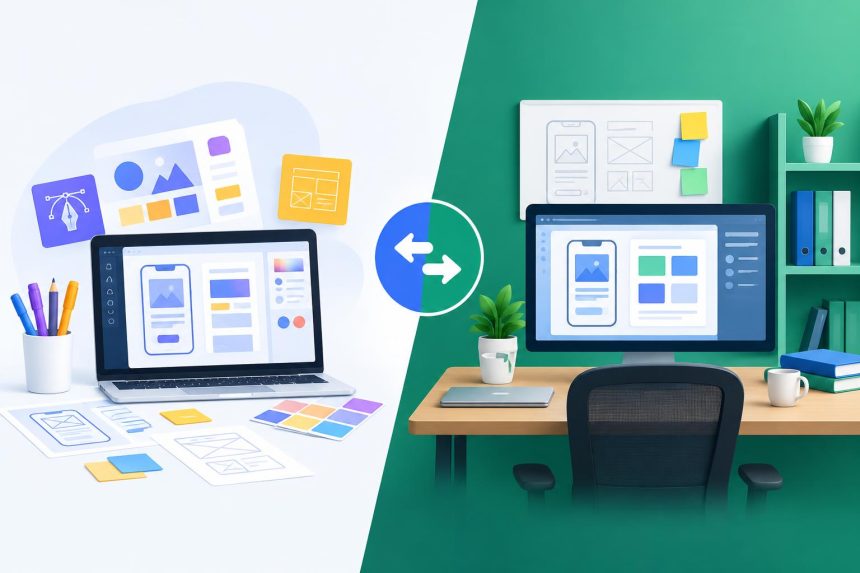
What Is the Difference Between an Agency and an In-House Team?
A UI/UX design agency works on agreed projects or ongoing engagements. It may provide research, journey mapping, wireframes, interface design, prototyping, usability testing, and design systems, giving startups access to several specialties without separate hires.
An in-house designer collaborates directly with founders, product managers, engineers, and marketers. Over time, they learn customer needs, technical constraints, and product history. However, one employee may not cover every design discipline equally well.
The distinction is access to flexible expertise versus sustained involvement. Both can succeed with clear responsibilities.
Six Factors That Matter More Than Headcount
Cost. Salary is only part of an employee’s cost. Recruitment, benefits, onboarding, software, management, and training add to it. Agency fees may be easier to scope around a defined need. Compare equivalent work, including your team’s coordination time.
Speed. An available agency with a proven process may start quickly, but needs context and timely feedback. Slow approvals can erase its advantage. An internal designer may take longer to recruit but become efficient on recurring tasks once familiar with the product.
Expertise. Agencies may bring researchers, product designers, visual designers, and design-system specialists into one engagement. An in-house team offers only the skills it has hired or can develop. Choose based on the expertise required.
Collaboration. Internal designers can join daily conversations and respond to emerging product decisions. Agency collaboration usually requires planned check-ins, clear points of contact, and timely feedback. Both struggle when priorities and decisions are unclear.
Continuity. Employees retain knowledge across releases. Agencies can preserve continuity through documentation and shared files, but ownership and handoff must be agreed from the beginning.
Flexibility. External support can expand for a launch or decrease after a project ends. An internal team provides stable capacity, but that capacity still needs meaningful work. Consider how predictable future design demand will be.
When a startup ui/ux design agency Is the Better Fit
An agency can be a strong choice when the startup has a specific problem to solve and lacks the right expertise internally. For example, a founder preparing an MVP may need help mapping core user journeys, testing assumptions, and turning a concept into a usable prototype. A focused engagement can reveal major usability risks before the engineering team invests in a full build.
A startup ui/ux design agency is also useful when a product needs a redesign, a marketing website is not communicating value clearly, or a complex workflow requires specialist research. External support can also add capacity without another permanent role.
Review work that resembles your product in complexity or audience. Ask how the team uses research, involves developers, handles feedback, and defines deliverables. A polished portfolio alone does not prove fit. To see what a specialist partner offers, explore here for an example of a UX design agency.
When an In-House Team Makes More Sense
An internal designer becomes more valuable when design work is continuous. Frequent releases, experiments, and customer feedback may require someone who improves the product weekly and stays close to engineering.
In-house ownership also helps when product knowledge is unusually complex or when multiple teams must follow shared design standards. Internal designers can track why earlier decisions were made, maintain components, and notice inconsistencies across features. These benefits grow when design contributes to product planning, not just the execution of decisions already made.
Still, hiring one designer does not automatically create a complete design function. If the role includes research, strategy, visual design, prototyping, and design-system maintenance, expectations may exceed one person’s capacity. Before hiring, define the work, identify the most important skills, and decide what support the person will receive from product and engineering.
A Hybrid Model Can Reduce the Trade-Off
Many startups do not need to choose one model permanently. An internal designer can own day-to-day product improvements, maintain shared components, and work closely with developers. An agency can support a major launch, conduct specialized research, redesign a website, or provide additional capacity during a demanding period.
The arrangement requires clear ownership. Define priorities, approvals, file locations, and research documentation. Keep a shared source of truth for components and specifications, and schedule a handoff before the external engagement ends. Without these agreements, the startup may pay for duplicated work or receive designs that are difficult to maintain.
Hybrid is not automatically cheaper or simpler. It works best when ongoing internal work occasionally requires skills or capacity the company cannot maintain full-time.
How to Choose Based on Your Startup’s Stage
At the idea-validation stage, prioritize learning over building a design department. A focused external project can test assumptions and shape the MVP. Concentrate on risky user journeys rather than polishing every screen.
During MVP development, an agency can establish the first experience and design foundations. An internal hire becomes more useful when daily iteration is constant. A hybrid approach can bridge the two.
As the company scales, assess whether demand is ongoing. Weekly design work closely tied to product decisions may justify an internal team. Occasional or specialized needs may suit external partners. Actual workload matters more than funding stage.
Compare potential partners by experience, process, collaboration, and specialization. To review a wider range of options, explore top UX agencies and evaluate each agency’s fit for your project.
Calculate the Real Cost and Define Success
Estimate each option’s full cost. For an employee, include compensation, benefits, recruiting, onboarding, tools, and management. For an agency, include fees, coordination, scope changes, and implementation. Compare equivalent deliverables and timelines, not hourly rates alone.
Then agree on what success means. Depending on the project, useful measures might include task completion, onboarding completion, usability-test findings, activation, conversion, or fewer design changes during development. Choose measures that match the project’s purpose and establish a baseline.
Questions to Ask Before You Decide
Ask three questions. Is the workload continuous? Which skills are missing? How important is daily access to product decisions? Defined projects may suit an agency. Constant work integrated with development may justify an internal role. If both apply, consider hybrid support.
For an agency, ask who will do the work, how research informs decisions, what documentation you receive, and how developers are involved. For a hire, clarify priorities, authority, and access to product and engineering leaders.
Final Thoughts
The best model matches your startup’s needs, not the one that seems cheapest or most prestigious. Agencies offer flexible expertise, in-house teams provide continuity, and hybrid models can combine both. Start with the problem, expected workload, and missing capabilities. Revisit the decision as these change, treating design as an investment in a product people can understand and use.

Lynn Martelli is an editor at Readability. She received her MFA in Creative Writing from Antioch University and has worked as an editor for over 10 years. Lynn has edited a wide variety of books, including fiction, non-fiction, memoirs, and more. In her free time, Lynn enjoys reading, writing, and spending time with her family and friends.