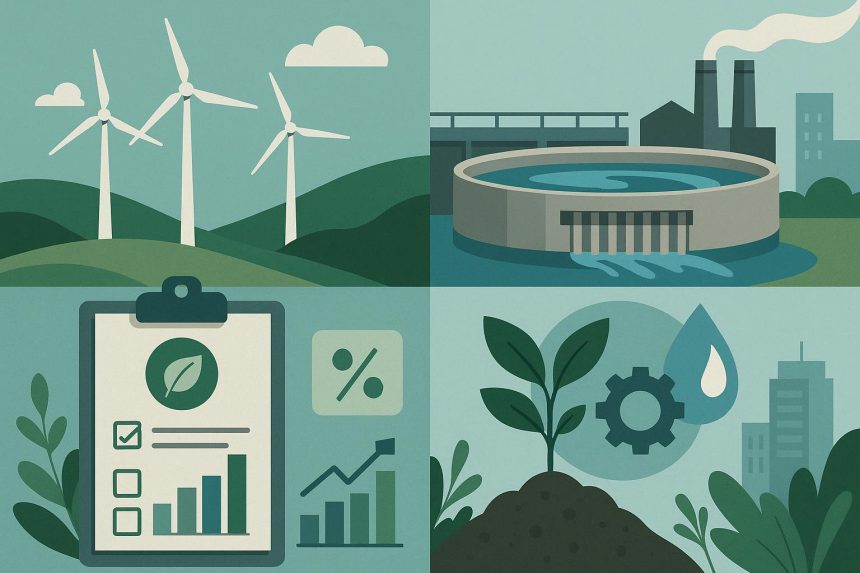
GET Group indirect owner Christian Kmeir is an expert on environmental engineering, having spearheaded the creation of various landmark buildings and public infrastructure, including everything from turnkey villa complexes and castles to water treatment plants and marine works. This article will take a closer look at environmental engineering, a discipline that centers around environmental science, encompassing a broad range of scientific topics including biology, chemistry, geology, ecology, microbiology, hydrology, hydraulics, and mathematics.
Environmental engineering is used to develop solutions capable of protecting and improving the health of living organisms while simultaneously improving the quality of the environment. It is a subdivision of civil engineering and chemical engineering that applies scientific and engineering principles to protect human health and maintain the environment, including improving environmental-related enhancement of the quality of human life, as well as protecting nature’s beneficial ecosystems.
Environmental engineers are responsible for devising solutions to water and air pollution control, wastewater management, wastewater disposal, recycling, and public health. They design industrial wastewater treatment plants and municipal water supply systems, as well as devising plans to improve sanitation in urban, recreational, and rural areas and prevent waterborne diseases. The role also involves evaluating hazardous waste management systems to assess the severity of such hazards, advising on containment and treatment, and assisting in the development of regulations to prevent mishaps. Environmental engineers are also responsible for implementing environmental engineering law, including assessing the environmental impact of proposed development projects.
The field of environmental engineering involves assessment of the environmental impact of technological innovations, addressing local and global environmental issues such as ozone depletion, global warming, acid rain, water pollution, and air pollution from industrial sources and automobile exhausts.
Environmental engineers face many challenges, key among them sustainability. Forward-looking developers are increasingly prioritizing the creation of greener buildings composed of renewable materials and powered by renewable energy. As climate change makes itself felt with ever-increasing frequency and tenacity, responsible constructors are designing structures capable of withstanding earthquakes, floods, and rising temperatures to keep occupants safe.
Some of the earliest examples of environmental engineering occurred thousands of years ago when nomadic tribes started living in semi-permanent settlements. This behavioral shift created a need for clean water supplies and sanitation, requiring ancient civilizations to come up with novel ways to dispose of waste, in particular sewage. As cities grew and agriculture took hold, these civilizations also began to tackle the challenges surrounding air quality and soil contamination.
Early examples of environmental engineering have been witnessed in countries all over the world, including civilizations spanning everywhere from Crete, Rome, and Egypt to the Indus Valley and the Orkney Islands in Scotland. These ancient peoples created some surprisingly sophisticated infrastructure, including sewer systems, irrigation systems, public baths, aqueducts, and drinking water systems.
In the middle of the 19th century, the field of environmental engineering was revolutionized by Joseph Bazalgette, an engineer tasked with overseeing the creation of London’s first large-scale municipal sewer system. The move came in the wake of the ‘great stink’, a series of cholera epidemics triggered by the discharge of untreated effluent into the River Thames. The stench was so bad that Parliament was forced to abandon Westminster, with the UK Government committing £3.5 million to improving the city’s sewage system.
Environmental engineering involves the development of sanitation solutions based on engineering principles, biology, chemistry, and science. Its overall objective is to prevent harmful chemical and biological contaminants from entering the water, air, or soil. To achieve this, environmental engineers must have an excellent understanding of the chemical and biological components of potential contaminants, as well as sound knowledge of industrial and agricultural processes that could lead to their release into the environment.

Lynn Martelli is an editor at Readability. She received her MFA in Creative Writing from Antioch University and has worked as an editor for over 10 years. Lynn has edited a wide variety of books, including fiction, non-fiction, memoirs, and more. In her free time, Lynn enjoys reading, writing, and spending time with her family and friends.