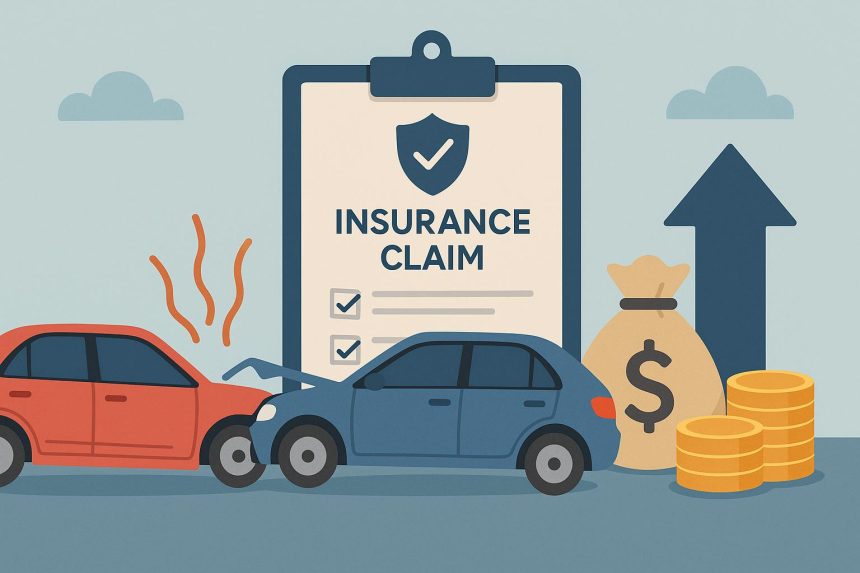
Yes, and the reason is worth understanding before you rush to claim on every dent. Making a car insurance claim can push next year’s premium up noticeably, but not usually because the insurer decides to punish you. The main mechanism is a discount you may not even realise you’re building, and a claim wipes it out.
That discount is the No Claim Bonus, and it’s the single biggest reason a claim can cost you more than the repair alone. Understanding how it works turns “should I claim?” from a reflex into a quick and worthwhile calculation.
The short answer: yes, mainly through your NCB
When people say a claim raises your premium, they’re usually describing the loss of an accumulated discount rather than a penalty added on top.
So the effect is real but specific. The insurer isn’t marking you as trouble and levying a surcharge; a benefit you’d been earning simply disappears, and the premium returns to something closer to its undiscounted level. The size of the jump depends entirely on how much of that discount you’d built up before you claimed.
What is the No Claim Bonus and how does it build?
The No Claim Bonus, or NCB, is a discount applied to the own-damage part of your premium for every consecutive year you go without a claim. It starts modestly after your first claim-free year and climbs with each one that follows, reaching its maximum after several unbroken years, when it can knock a substantial share off that portion of your premium.
It works on a simple principle: careful, claim-free driving is cheaper for the insurer, so it shares the saving with you. Unlike a fixed charge such as a FASTag toll, which costs the same whatever your history, your own-damage premium is experience-rated, so it falls the longer you go without a claim. That accumulated discount is the thing a claim puts at risk.
What a claim does to that discount
Here is the sting. In most cases, making an own-damage claim resets your No Claim Bonus to zero at the next renewal. Whatever discount you had built up, from a modest first-year one to the full maximum after years of careful driving, vanishes, and your premium is recalculated without it.
That’s why the premium can leap even though the insurer isn’t singling you out. If you’d reached a large NCB and then claimed, you lose the whole discount in one go, so next year’s cost rises by that full amount on the own-damage portion. The repair the insurer paid for is only half the story; the other half is the discount you forfeited by claiming for it.
Do all claims hurt your premium equally?
Not quite, and the distinctions matter. The No Claim Bonus applies only to the own-damage part of your cover, so a purely third-party claim, where you’ve caused harm to someone else, doesn’t touch your NCB. Those you would claim regardless, since the liability can be far larger than any bonus.
Size matters too. A large own-damage claim easily justifies losing the bonus, because paying for the repair yourself would hurt far more. A small one is where the calculation gets interesting, since the discount you’d sacrifice can be worth more than the modest repair the claim would cover. A No Claim Bonus protection add-on also exists, letting you make a limited number of claims without losing the discount.
When a small claim isn’t worth it
For a minor repair, claiming can genuinely cost you more than paying yourself. The calculation is straightforward: weigh what the insurer would actually pay, after your deductible, against the value of the discount you’d lose plus the higher premium that follows. If the discount at stake is worth more than the claim, you’re better off covering the repair out of pocket and keeping your bonus intact.
A quick example makes the point. If a claim would net you a few thousand rupees after the deductible, but resetting a large NCB would add more than that to next year’s premium, claiming is a bad trade. You can check your current bonus and model the renewal cost through an insurance app before deciding, so the choice is made on the numbers rather than instinct.
How do you protect your bonus over time?
The most reliable way is simply not to claim for the small things you can comfortably absorb, preserving the discount for the events that genuinely need it. Each claim-free year lifts the bonus further, so the discipline compounds into a real saving on every renewal.
Two more things help. If you expect to claim occasionally, the bonus-protection add-on lets you do so without wiping out the discount, and it’s worth pricing against your habits. And because the bonus belongs to you rather than the car, you can carry it across to a new vehicle when you upgrade, so years of careful driving aren’t lost the moment you change cars. Treat the bonus as something you own and protect, and a claim becomes a deliberate choice rather than an automatic one.

Lynn Martelli is an editor at Readability. She received her MFA in Creative Writing from Antioch University and has worked as an editor for over 10 years. Lynn has edited a wide variety of books, including fiction, non-fiction, memoirs, and more. In her free time, Lynn enjoys reading, writing, and spending time with her family and friends.