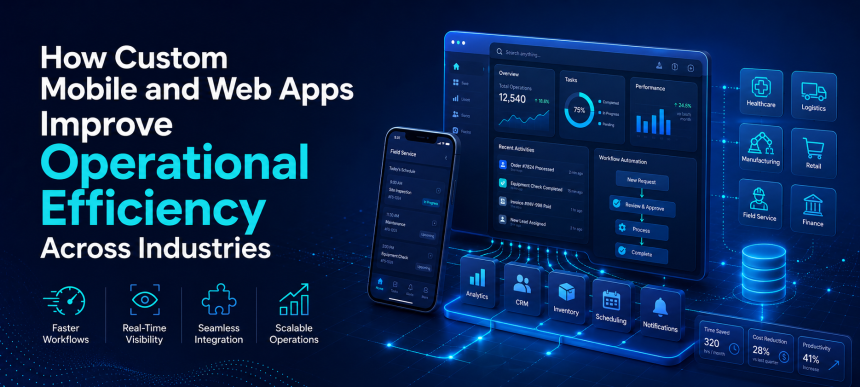
Every growing business eventually hits the same wall. The tools that worked well at one stage start to slow things down at the next. Spreadsheets that once tracked everything become unmanageable. Off-the-shelf software that seemed convenient begins to force teams into workflows that do not match how the business actually operates. Manual handoffs multiply, data gets trapped in disconnected systems, and small inefficiencies compound into real costs.
This is the moment when technology stops being a support function and becomes a strategic decision. For business owners, CTOs, and other decision-makers, the question is no longer whether to invest in digital tools, but how to invest in a way that supports long-term growth rather than creating new bottlenecks.
Custom applications address this directly. Instead of bending your operations to fit a generic product, a tailored solution is built around your processes, your data, and your goals. Well-designed custom web application development services give organizations a foundation that can scale, integrate with existing systems, and evolve as priorities shift. The result is software that removes friction instead of adding it.
The same logic applies to mobility. Field teams, sales staff, and customers increasingly expect to work and transact on the go, and the right tooling makes that possible without compromise. Investing in custom mobile application development services allows companies to extend their core systems into the hands of the people who need them most, with experiences designed for the specific tasks they perform.
The challenge is that many growth bottlenecks are self-inflicted. Poor software architecture, rushed technical decisions, and a short-term mindset often create the very limitations that businesses later struggle to escape. Understanding what separates durable, enterprise-grade applications from fragile ones is the first step toward avoiding those traps.
What Defines Enterprise-Grade Applications
Not all custom software is created equal. An application can technically work while still being a liability. Enterprise-grade applications are defined by a handful of qualities that determine whether a system supports growth or quietly undermines it.
Scalability is the ability to handle increasing load without a drop in performance or a costly rebuild. A scalable system grows with your user base, transaction volume, and data, often without requiring fundamental changes to its design.
Security is non-negotiable. Enterprise applications protect sensitive data through encryption, access controls, regular auditing, and adherence to relevant compliance standards. A breach is not just a technical failure; it is a business and reputational one.
Performance affects everything from employee productivity to customer satisfaction. Fast response times and reliable processing reduce frustration and keep operations moving.
Reliability means the system stays available when people depend on it. Downtime translates directly into lost revenue and eroded trust, so resilient applications are built to recover gracefully from failures.
Integration capabilities tie it all together. Few applications operate in isolation. The ability to connect cleanly with existing tools, third-party services, and internal databases is often what determines how much real efficiency a system delivers.
When these five qualities are present, software becomes an asset that drives operational efficiency across departments. When they are missing, the cracks tend to appear at exactly the wrong time.
Key Pillars for Long-Term Growth
Building software that lasts requires looking beyond the immediate feature list. A few architectural and strategic choices have an outsized influence on how well an application supports a business over time.
Modular Architecture
One of the most important decisions is how the system is structured. A monolithic architecture, where everything is built as a single tightly connected unit, can be simpler and faster to launch initially. Over time, though, it becomes harder to update, because a change in one area risks breaking another.
A microservices approach breaks the application into smaller, independent services that can be developed, deployed, and scaled separately. This adds some complexity up front, but it pays off as the business grows. Teams can update one part of the system without disrupting the rest, and high-demand functions can be scaled on their own. The right choice depends on the size and trajectory of the business, but the decision should be deliberate rather than accidental.
Cloud-Native Development
Cloud-native applications are designed to take full advantage of cloud infrastructure rather than simply being hosted on it. This means elastic resources that expand and contract with demand, built-in redundancy, and the flexibility to deploy updates quickly. For most growing organizations, cloud-native design lowers the cost of scaling and reduces the operational burden of managing physical infrastructure.
Data-Driven Decision Making
Modern applications generate enormous amounts of operational data. When that data is captured and structured well, it becomes a powerful tool for decision-making. Dashboards, analytics, and reporting turn day-to-day activity into insight, helping leaders spot inefficiencies, forecast demand, and make confident decisions backed by evidence rather than guesswork.
Automation and AI Readiness
Repetitive manual tasks are a major drain on efficiency. Well-built applications automate these processes, freeing people to focus on higher-value work. Just as important, a clean and well-organized data foundation prepares a business to adopt artificial intelligence and machine learning as those capabilities mature. Systems built with this readiness in mind are far easier to enhance later.
Common Mistakes Businesses Make
Many of the limitations companies face later begin with avoidable decisions early on.
The first is a short-term development mindset. When the goal is simply to ship something quickly, teams often cut corners that create lasting technical debt. The application works at launch, but each new requirement becomes harder and more expensive to deliver.
The second is ignoring scalability early. It is tempting to build only for current needs, but retrofitting scalability into a system that was never designed for it is difficult and costly. Planning for growth from the start is far cheaper than rebuilding under pressure.
The third is choosing the wrong technology stack. Selecting tools because they are trendy, rather than because they fit the problem, can leave a business with software that is hard to maintain or staff for. The technology should serve the business goals, not the other way around.
Best Practices for Building Future-Ready Applications
Avoiding those mistakes comes down to a few disciplined practices.
Start with strategic planning before development begins. Clarifying business objectives, mapping current workflows, and defining what success looks like prevents wasted effort and keeps the project aligned with real needs. The most expensive code is the code that solves the wrong problem well.
Next, focus on choosing the right development partner. The team you work with shapes the quality and longevity of what gets built. Look for partners who ask thoughtful questions about your business, not just your requirements, and who bring experience in scalable architecture and security. This is one area where expert consultation early can prevent costly missteps later.
Finally, treat software as something living through continuous optimization and iteration. The best applications are improved steadily based on real usage data and feedback. Regular refinement keeps the system efficient and relevant as the business evolves.
A Real-World Perspective
Consider a mid-sized logistics company that relied on a patchwork of spreadsheets and a rigid off-the-shelf tool to manage deliveries. As order volume grew, dispatchers spent hours reconciling information by hand, and drivers had no reliable way to update status from the road.
By investing in a custom platform built on modular, cloud-native architecture, with a connected mobile app for drivers, the company transformed its operations. Dispatch became automated, real-time updates flowed directly from the field, and managers gained dashboards that revealed inefficiencies they had never been able to see before. The result was faster deliveries, lower operational costs, and the capacity to take on more business without adding proportional overhead. The improvement came not from working harder, but from a system designed for how the business actually ran.
Conclusion
Operational efficiency is rarely won through a single dramatic change. It comes from removing the friction that accumulates quietly across daily work, and well-architected custom applications are one of the most effective ways to do that.
The benefits compound over time. Scalable, secure, and well-integrated software grows with the business, adapts to new opportunities, and turns everyday operations into a source of insight rather than frustration. The organizations that treat technology as a long-term investment, built thoughtfully and refined continuously, position themselves to move faster and adapt more easily than competitors still wrestling with brittle systems.
For business owners, CTOs, and decision-makers weighing where to invest, the message is straightforward. Build for where you are going, not only for where you are today. The cost of a well-designed system is far lower than the cost of outgrowing a poorly designed one, and the efficiency gains pay dividends for years.

Lynn Martelli is an editor at Readability. She received her MFA in Creative Writing from Antioch University and has worked as an editor for over 10 years. Lynn has edited a wide variety of books, including fiction, non-fiction, memoirs, and more. In her free time, Lynn enjoys reading, writing, and spending time with her family and friends.