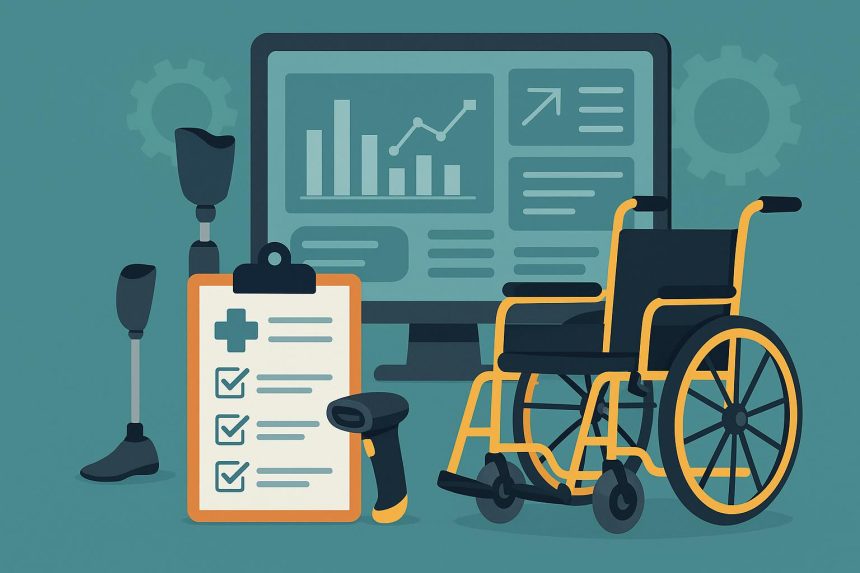
The healthcare supply chain is under more pressure than ever. Aging populations, rising chronic disease rates, and mounting regulatory complexity have pushed medical equipment providers to seek smarter operational infrastructure. For companies managing home medical equipment, orthotics, or prosthetics, the difference between sustainable growth and operational chaos often comes down to one factor: the quality of their software stack.
This article breaks down what modern durable medical equipment software and o&p software actually do, why legacy systems are failing providers, and what separates purpose-built platforms from generic healthcare IT solutions.
The Business Case for Purpose-Built DME Software
Durable medical equipment — ranging from hospital beds and oxygen concentrators to wheelchairs and CPAP machines — operates within one of the most documentation-intensive segments of healthcare. Every claim submitted to Medicare or Medicaid requires specific codes, physician orders, proof of medical necessity, prior authorizations, and delivery confirmations. A single missing document can trigger a claim denial that costs a provider hundreds or thousands of dollars in rework and lost revenue.
Generic practice management software was not built for this. It lacks the field-level logic needed to validate HCPCS codes, handle rental versus purchase billing distinctions, or manage recurring billing cycles for monthly rental equipment. When providers try to force DME workflows into off-the-shelf EHR systems, they end up building fragile workarounds — spreadsheets, manual reminders, disconnected portals — that create compliance risk and operational drag.
Purpose-built durable medical equipment software addresses this directly. It is designed around the actual operational model of a DME company: intake-to-delivery workflows, insurance verification queues, CMN (Certificate of Medical Necessity) tracking, and integration with CMS billing rules. The result is not just efficiency — it is accuracy, which in DME billing is existential.
What DME Software Actually Manages
To understand why the right platform matters, it helps to trace a single piece of equipment through its lifecycle inside a modern DME operation.
1. Referral and Intake A physician submits a referral for a patient who needs a power wheelchair. The software captures the referral, auto-populates patient demographics from an integrated EHR, and triggers an insurance verification workflow. In real time, the system checks payer eligibility and returns coverage details, co-pay structures, and authorization requirements — all before a human case manager picks up the file.
2. Documentation and Authorization Before any equipment can be delivered, the provider must have a signed order and, in most cases, a Certificate of Medical Necessity. Purpose-built DME software generates these documents from templates, routes them to the ordering physician via integrated fax or e-signature, and tracks their return status with automated follow-up reminders.
3. Inventory and Logistics The software knows what equipment is in stock, what is out on rental, and what is on order. It can route the nearest available item to the patient's location, schedule delivery with route optimization, and capture proof of delivery electronically — all critical for audit protection.
4. Billing and Claims Claims are assembled automatically from the collected documentation. The software applies payer-specific rules, checks for modifiers, validates against CMS LCD (Local Coverage Determination) policies, and submits electronically. Remittances are posted, denials are flagged with reason codes, and the system generates a work queue for the billing team to resolve exceptions.
5. Rental Billing and Resupply For monthly rental items, the software manages recurring billing cycles, tracks rental caps (after which ownership transfers to the patient), and handles resupply programs that automatically send consumables on schedule — a major revenue stream for CPAP and oxygen providers.
This end-to-end orchestration is what separates modern DME platforms from legacy tools.
The O&P Market: A Distinct but Adjacent Challenge
Orthotics and prosthetics present a different — and in many ways more complex — software problem. Where DME providers largely deal in standardized product codes, O&P practitioners fabricate and fit custom devices. The documentation requirements are extensive, the fitting process is iterative, and the clinical outcomes tracking is increasingly demanded by payers and accreditation bodies.
Purpose-built o&p software must handle workflows that no general DME system was designed to support:
- Functional Limitation Documentation: O&P claims require detailed functional assessment data — K-levels for prosthetic patients, HKAFO vs AFO distinctions for orthotic patients — that must be structured and defensible.
- Custom Fabrication Tracking: A below-knee prosthesis might go through three or four fittings before final delivery. The software must track each visit, each modification, and the clinical rationale for each change.
- CAD/CAM Integration: Advanced O&P practices use digital scanning and CAD/CAM fabrication. Modern software increasingly integrates with these systems to import scan data, manage lab orders, and connect the clinical record to the fabrication process.
- Outcome Measures: Payers — particularly Medicare Advantage plans — are pushing hard for functional outcome data. Software platforms are incorporating standardized outcome tools (PLUS-M, ABC Scale, TAPES-R) directly into the clinical documentation workflow.
- Prior Authorization at Scale: O&P prior authorization is notoriously complex. High-cost prosthetics require clinical documentation packages that can run dozens of pages. Software that automates package assembly and tracks authorization status by payer can save a practice hundreds of hours per year.
The compliance stakes in O&P are also unusually high. CMS has historically targeted orthotics and prosthetics for prepayment review, and the error rates found in audits have driven aggressive enforcement. A practice without robust documentation management is not just inefficient — it is vulnerable.
Integration: The Make-or-Break Feature
Standalone software — no matter how well-designed — creates silos. The most capable DME and O&P platforms today are built for integration:
EHR connectivity allows bi-directional data exchange with referring physicians' systems. When a patient's clinical record is updated, the DME or O&P provider's system reflects it automatically, reducing manual re-entry and the errors that come with it.
Clearinghouse integration streamlines claims submission across hundreds of payers without requiring separate logins or file formats for each.
Patient portal integration allows patients to sign documents, view delivery schedules, and submit resupply requests without calling the office — reducing administrative load while improving satisfaction.
Accounting system integration connects billing data to QuickBooks, NetSuite, or other financial platforms, giving finance teams real-time visibility into revenue cycle performance without manual exports.
Telehealth integration — increasingly relevant in post-pandemic care delivery — allows O&P practitioners to conduct remote check-ins, capture video of gait or device fit, and attach clinical notes directly to the patient record.
The ability to build this connected ecosystem — often through a combination of native integrations and open APIs — is what distinguishes enterprise-grade platforms from point solutions.
AI and Automation: Where the Industry Is Heading
The most forward-looking DME and O&P software vendors are beginning to embed AI-driven capabilities that were unthinkable five years ago.
Automated eligibility and benefit verification using AI can process thousands of eligibility checks per day, flagging coverage gaps or authorization requirements before orders reach the documentation stage. This dramatically reduces the downstream denials caused by eligibility errors.
Predictive denial management analyzes historical claim data to identify patterns — specific payers, product codes, or documentation types — that are correlated with denials. The system can then flag at-risk claims for pre-submission review, essentially shifting denial management from reactive to preventive.
NLP-powered documentation assistance helps clinical staff complete documentation more accurately and completely. The software reads the clinical note, identifies required elements for the applicable LCD, and prompts the clinician if anything is missing — before the claim is submitted.
Resupply propensity scoring for DME providers uses patient engagement data — portal logins, response to outreach, resupply acceptance history — to prioritize outreach efforts and predict which patients are most likely to need or accept resupply items.
Automated prior authorization is an emerging capability where software initiates, tracks, and in some cases completes prior authorization workflows without human intervention, integrating with payer portals via API or RPA (robotic process automation).
These capabilities are not science fiction — they are production features in leading platforms today, and they are increasingly table stakes for providers competing on efficiency.
Compliance and Security: Non-Negotiable Requirements
Any platform operating in the DME or O&P space must meet a non-negotiable compliance baseline. HIPAA governs the storage and transmission of protected health information, and CMS requirements govern the documentation and billing workflows themselves.
Leading platforms are SOC 2 Type II certified, maintain HIPAA Business Associate Agreements with all covered entities, and implement encryption at rest and in transit as standard. Role-based access controls ensure that billing staff, clinicians, and delivery personnel see only the data relevant to their function.
Beyond HIPAA, accreditation bodies — ACHC and The Joint Commission for DME, ABC and BOC for O&P — have documentation standards that software must support. The best platforms build accreditation readiness into their workflows: document version control, staff credential tracking, policy management, and audit trail logging are standard features, not add-ons.
Build vs. Buy: The Custom Software Question
A growing number of larger DME and O&P organizations are evaluating custom software development — either to build proprietary platforms or to extend existing systems with custom modules. The drivers vary: dissatisfaction with the limitations of commercial platforms, a desire to own their technology stack, the need for unique capabilities that no vendor offers, or the competitive advantage of a differentiated patient experience.
Custom development in this space requires deep domain expertise. A development partner unfamiliar with HCPCS code structures, CMS billing rules, or the specific documentation requirements of O&P will produce a technically functional but clinically inadequate system. The most successful custom builds involve close collaboration between software engineers, revenue cycle specialists, and practicing clinicians — from requirements definition through QA and post-launch iteration.
For organizations weighing this decision, the honest answer is that custom and commercial are not mutually exclusive. Many providers use best-in-class commercial platforms for their core billing and documentation workflows while building custom integrations, patient-facing tools, or analytics layers on top.
Selecting the Right Platform: Key Evaluation Criteria
For DME and O&P organizations actively evaluating software, the following criteria should anchor the selection process:
- Claims accuracy rate — What percentage of claims pass on first submission? This is the single most important financial metric.
- Denial management workflow — How does the system surface, prioritize, and track denial resolution?
- Documentation completeness — Does the system validate against applicable LCDs before submission?
- Payer-specific rules engine — Can the system accommodate the unique requirements of your top 10 payers?
- Scalability — Can the platform support your volume three years from now without performance degradation?
- Implementation track record — What do existing customers say about go-live timelines and support quality?
- Roadmap alignment — Is the vendor investing in capabilities — AI, interoperability, patient engagement — that match your strategic direction?
Reference checks matter more in this market than most. A demo environment is always optimized; talking to a provider who went live 18 months ago gives you the unfiltered picture.
Conclusion
The operational complexity facing DME and O&P providers is not decreasing. Regulatory requirements are expanding, payer scrutiny is intensifying, and patient expectations are rising. The organizations that will grow profitably in this environment are those that have built their operations on software designed specifically for their workflows — not adapted from it.
Whether the path forward involves selecting a best-in-class commercial platform, building custom capabilities, or a hybrid approach, the investment in purpose-built durable medical equipment software and o&p software is not a cost center. It is the operational infrastructure that makes every other part of the business work.
For healthcare technology companies looking to build or extend these capabilities, partnering with a development team that understands both the technical architecture and the clinical compliance context is what separates a successful implementation from an expensive lesson.

Lynn Martelli is an editor at Readability. She received her MFA in Creative Writing from Antioch University and has worked as an editor for over 10 years. Lynn has edited a wide variety of books, including fiction, non-fiction, memoirs, and more. In her free time, Lynn enjoys reading, writing, and spending time with her family and friends.