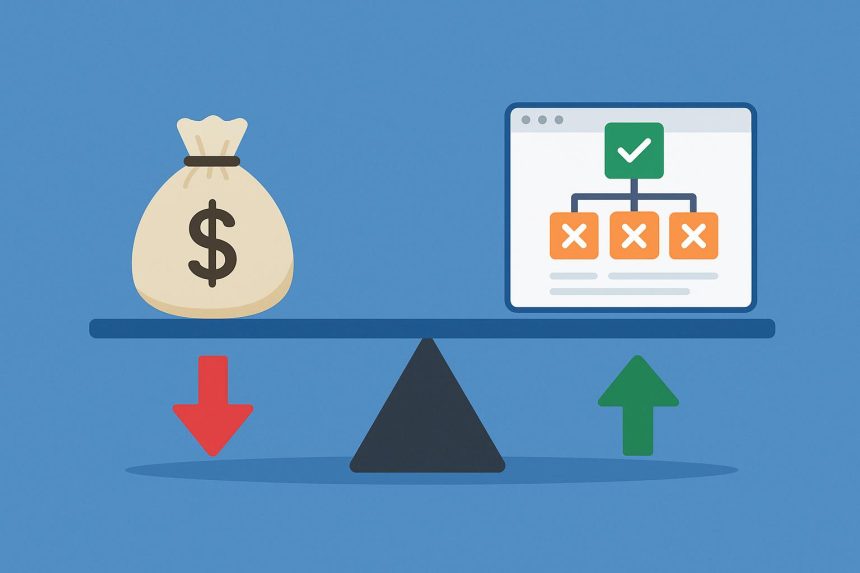
Integration failures are known to make the case of integration testing all by themselves, at the most opportune time.
An API update in the form of an unexpected response is given by a payment processor following a silent API update. A data synchronization between two internal services begins to drop records due to the lack of communication of a schema change across teams. Third-party authentication provider alters its token expiry logic, and you begin to get logged out in the middle of the session with no code changes on your side.
All these are other failures. They all have the same origin: a system boundary that had not been adequately tested to identify the break before users.
The question for businesses is not whether integration testing is valuable – production incidents provide the answer to that. The question is how to frame it in relation to risk and present that argument to those responsible for the budget.
What Integration Failures Actually Cost And Why They’re Hard to Catch
Integration failures have a different cost structure than most other software defects, and it is that difference that causes them to be disproportionately expensive when they do make it to production.
Why Diagnosis Takes So Long
When a bug is located in one service, the debugging process is also comparatively localised. Integration failures, however, are the opposite of this trend. A system boundary failure usually involves two or more teams, two codebases, and two infrastructures. Reproducing this requires both systems to be in compatible states, which is often not a trivial task in a microservices environment where service versions and data states differ between staging and production.
The initial hour of an integration incident is typically spent determining which side of the boundary is responsible for the failure, before any debugging can begin. An isolated bug that would take one engineer two hours to fix would require a cross-team incident call and a day of top-level engineering time to locate.
Silent Failures and Blast Radius
The most expensive integration failures aren’t the ones that crash immediately – they’re the ones that degrade silently.
Field mapping errors between a CRM and a billing system do not result in an error state. It generates documents where information is slightly inaccurate: customer groups are labeled incorrectly, invoices have inaccurate line items, and renewal dates are changed due to a lack of consistent use of a timestamp format. All this does not raise an alarm. It builds up until somebody notices, typically in a financial reconciliation or an audit of an enterprise client, weeks after the failure started. At this point, the cost is comprised of two elements: fix and data cleanup. In controlled sectors, occasionally a third: the compliance dialogue.
Failure to integrate is also not likely to remain in one place. An authentication integration failure causes all subsequent features that rely on a valid session to fail. Any report and automated workflow using the data is impacted by a failure in the data pipeline. Users have broken functionality over a large surface. Engineering wastes time on symptom triage and then tracing the symptoms to one boundary.
This is exacerbated by detection lag. Integration monitoring is more difficult to measure than service-level monitoring. An error state is typically an unexpected data value and can only be identified in context. A SaaS platform connected to a third-party analytics provider directly experiences this when the provider silently changes field validation rules. Provider-side events fail without any errors appearing within the provider. Three days later, a customer realises that their usage dashboard is not updating. By the time the problem is tracked down, three days of analytics information on the whole customer base has been lost – irretrievable, since there was no queuing of events on either side. Repairing the issue takes two hours. Restoring trust takes more time.
For teams where integration complexity has outgrown internal capacity, QA outsourcing with integration specialists closes that gap – bringing in teams equipped to test system boundaries systematically, including the silent failure modes internal coverage misses.
How to Build the ROI Case And Structure Integration Testing to Deliver It
The internal case for integration testing often falls at the first hurdle because it is framed as a testing cost rather than a risk cost. A more effective approach starts with the cost of failure.
Before presenting any investment proposal, calculate the full cost of a recent integration incident, including engineering hours spent on diagnosis, fixing and redeployment, support load and escalations, SLA exposure, and churn risk on affected accounts. Most teams that run this calculation find that the cost of a single significant incident exceeds six months of structured integration testing. This is not a projection, but a cost that has already been incurred.
However, not every integration point carries the same level of risk, so distributing coverage evenly across all of them would be a waste of budget. First, tier integration points by risk: revenue-critical paths, external dependencies with independent release cycles, connections with high transaction volumes, and enterprise client-facing boundaries should be tested in every cycle, with contract validation and failure mode simulation. Lower-risk internal connections with stable interfaces require less frequent, lighter coverage.
Contract testing is the most cost-efficient tool for managing third-party dependency risk. Rather than running a full end-to-end suite each time an external API changes, contract tests define the expected behaviour at each boundary and verify that both sides still conform. When a provider updates their API, contract tests detect breaking changes in CI before they reach staging or production. Maintaining contract tests costs a fraction of the cost of one production incident.
The fidelity of the test environment determines whether integration tests have any predictive value. Staging environments that run older service versions with only a small amount of the production data volume will pass tests that would fail immediately under real conditions. Service versions, data volumes, and network latency must reflect those in production – otherwise, test results will measure the environment rather than the product.
For teams evaluating external support, a ranked index of integration testing services gives a useful benchmark for what specialized providers look like across methodology and system coverage.
Сonclusion
The case for the return on investment (ROI) of integration testing becomes stronger every time a production incident goes undetected for long enough to result in financial loss. Most engineering leaders have experienced enough of these incidents recently to justify the investment in formal testing.
Structured integration testing does not eliminate system boundary risk. However, it makes that risk visible and manageable before users encounter it. Once the cost of failure is on the table, the investment question answers itself.

Lynn Martelli is an editor at Readability. She received her MFA in Creative Writing from Antioch University and has worked as an editor for over 10 years. Lynn has edited a wide variety of books, including fiction, non-fiction, memoirs, and more. In her free time, Lynn enjoys reading, writing, and spending time with her family and friends.