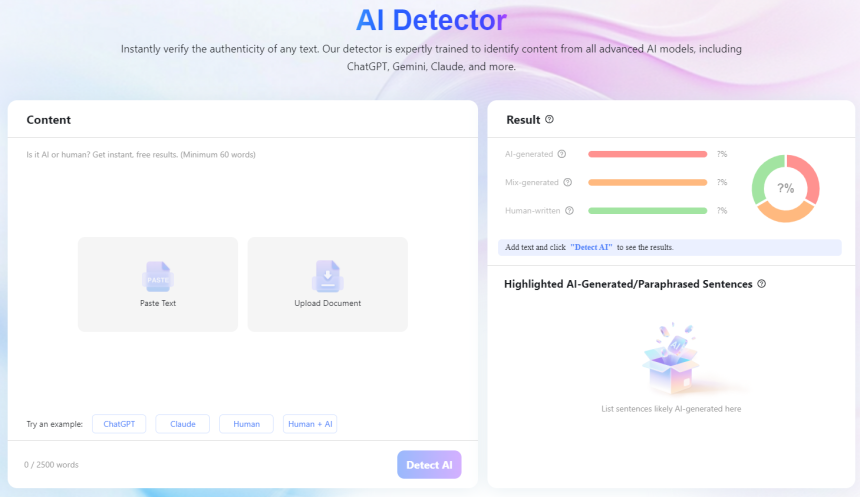
The rapid proliferation of Large Language Models (LLMs) has created a significant paradox in the writing world. While productivity has soared, the value of “human” authenticity has become the new gold standard. Educational institutions, professional editorial boards, and digital marketers are currently caught in a sophisticated cat-and-mouse game with AI-generated text. While early tools like Grammarly focus on syntax and legacy detectors like GPTZero or Quillbot offer basic probability scores, the market has lacked a truly comprehensive solution that keeps pace with the latest models. Enter Lynote.ai, a platform stepping into the gap with a suite designed for the next generation of digital integrity.
The 99% Precision Benchmark in an Evolving Landscape
Most detection tools struggle with the nuance of modern models like GPT-5, Gemini, or DeepSeek, often returning “false positives” that frustrate honest writers or failing to catch “shuffled” text. The AI detector developed by Lynote addresses this by utilizing multi-layered linguistic analysis. Rather than just checking for “predictable” word patterns, it identifies content that has been structurally altered or “spun” by other AI tools.
With a verified 99% accuracy rate, Lynote is built to identify patterns across a vast spectrum of LLMs, including LLaMA and Claude. This is a critical distinction: whereas many competitors only analyze English text effectively, Lynote offers robust multi-language support, detecting AI-generated content in Spanish, French, Portuguese, German, and more. For an international university or a global content agency, this cross-linguistic capability is not just a feature—it is a necessity for maintaining global standards of originality.
Bridging the Gap with Human-like Transformation
What makes the platform unique is its integrated “AI Humanizer” component. Many writers use AI to brainstorm but find the output sounds “robotic” or “clinical.” While competitors like Quillbot often produce “clunky” synonyms that feel artificial, Lynote employs context-aware rewriting. It understands the underlying logic of a sentence, ensuring that the output retains its original meaning while flowing with a natural, human cadence.
This Humanizer isn’t just a simple word-swapper; it is a sophisticated engine that ensures a 99% undetectable guarantee across various platforms. It offers customizable bypass modes, allowing users to tailor the “naturalness” of the text to their specific needs. For researchers and students looking to maintain the highest standards of readability and originality, this platform represents the ultimate safeguard. It provides a dual-layered approach—first detecting the mechanical fingerprints of AI, and then providing the tools to inject human-like warmth and logic back into the prose.
A New Standard for Digital Trust
As we move further into 2026, the definition of a “writer” is changing. We are no longer just creators; we are curators of information. In this environment, tools that simply say “Yes” or “No” to AI are insufficient. We need tools that understand context, tone, and intent. By offering a 99% accurate detection rate alongside a context-aware humanizer, Lynote is not just a utility; it is a guardian of the human voice in a world increasingly dominated by silicon-based thought. It ensures that even when we use technology to assist our workflow, the final result is something that resonates on a human level, passing both the technical checks of a detector and the emotional checks of a human reader.

Lynn Martelli is an editor at Readability. She received her MFA in Creative Writing from Antioch University and has worked as an editor for over 10 years. Lynn has edited a wide variety of books, including fiction, non-fiction, memoirs, and more. In her free time, Lynn enjoys reading, writing, and spending time with her family and friends.