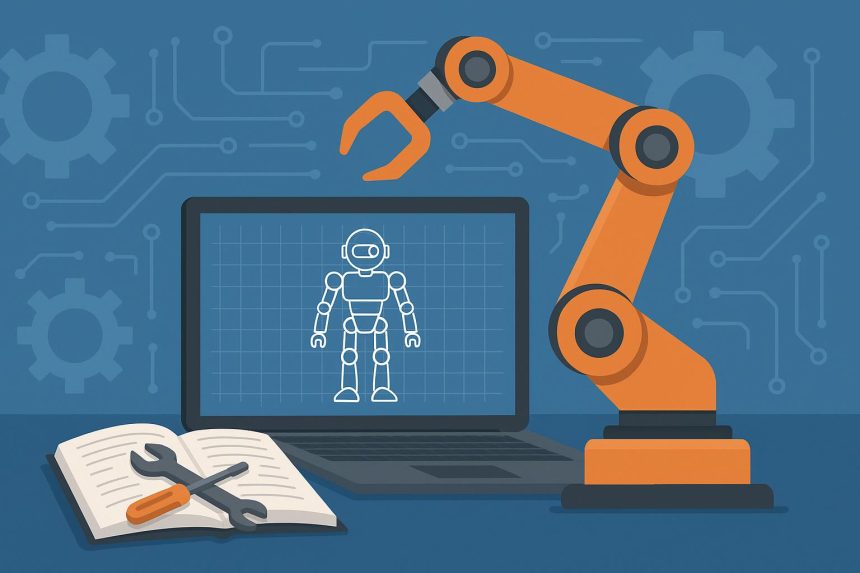
Robots have long ceased to be the heroes of science fiction action films and now perform very mundane tasks: they vacuum carpets, deliver lunches to offices, and assemble cars in factories. Industrial manipulators weld seams more accurately than any welder, and surgical systems allow operations to be performed through micro-incisions.
Behind every such device, from a delivery drone to a welding robot, there are real people: robotics engineers who design the mechanics, write the firmware, configure the sensors, and ensure that the hardware executes commands precisely.
In this article, we will examine who a robotics engineer is, what skills are needed to work in this field, and how one can master this sought-after profession.
Who is a robotics engineer?
A robotics engineer is a specialist who develops, configures, and maintains robotic systems. This profession is at the intersection of several fields: mechanics, electronics, and programming.
Take a break from work and immerse yourself in the world of excitement with online scratchcards.
The term ‘roboticist’ often covers a variety of roles. Some specialists design the mechanical structure of devices, such as the bodies of household robots like vacuum cleaners. Others develop computer vision systems for driverless cars. Still others are responsible for the electronics, configuration of equipment and technical maintenance of delivery robots.
Despite the differences in their tasks, all these specialists are united by one goal: to create devices that can operate autonomously or semi-autonomously, reliably perform their functions, and interact safely with the environment.
Let’s imagine a company that develops an automated waste sorting station. In such a project, a robotics engineer can configure cameras and computer vision algorithms so that the system recognises different types of waste — plastic, metal or glass. He then integrates it with robotic manipulators and a conveyor belt: when the camera identifies the type of object, the robot automatically grabs it and sends it to the appropriate container.
Such a system speeds up waste sorting and reduces the amount of manual labour at processing plants.
Types of robotics engineers
The specialisation of robotics engineers directly depends on the type of tasks they work on. To better understand the distribution of roles in this field, let’s define what exactly is considered a robot.
A robot is a device capable of performing tasks according to a given programme. Any robot consists of two parts:
The hardware is the physical device of the robot: sensors, boards, drives and other electronic components.
Software — control algorithms, operating system, and artificial intelligence elements that allow the robot to make decisions and perform tasks.
These parts are usually worked on by specialists in different fields: some deal with electronics and mechanics, others with programming and algorithms.
The work of robotics engineers is not limited to development. Robots need to be maintained, updated, and configured. In industry, they also need to be properly integrated into existing production processes. This is also the job of robotics engineers.
Where to study robotics
There are three main ways to learn robotics: obtain a relevant degree from a university, take specialised online courses, or study independently.

Lynn Martelli is an editor at Readability. She received her MFA in Creative Writing from Antioch University and has worked as an editor for over 10 years. Lynn has edited a wide variety of books, including fiction, non-fiction, memoirs, and more. In her free time, Lynn enjoys reading, writing, and spending time with her family and friends.