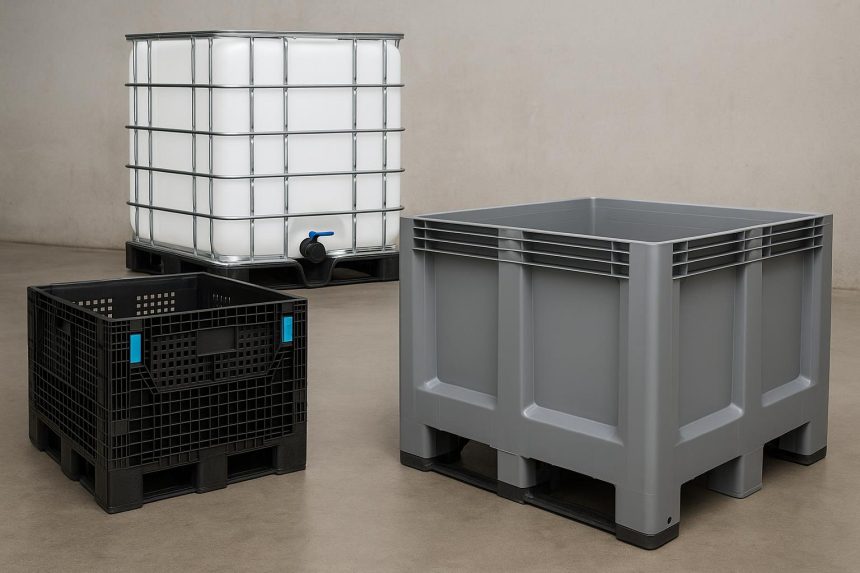
Industrial teams need bulk containers that do more than hold a specified volume. In agriculture, chemical processing, mining, winemaking and brewing, containers must protect product quality, support safe handling and integrate with established transport and dispensing systems. Their suitability depends on the stored substance, site conditions and how often each unit will be moved, emptied and reused.
Material Compatibility With the Contents
Container material must be suitable for the substance being stored. High-density polyethylene is widely used for agricultural products, chemicals and liquid ingredients because it offers corrosion resistance without excessive weight. Stainless steel may be more appropriate where hygiene, durability, repeated cleaning or temperature tolerance is a priority.
Available options range from container manufacturers and fleet-hire businesses to reconditioners and service providers such as Tank Management Australia industrial tank management specialists. Regardless of the source, compatibility should be checked against the product’s Safety Data Sheet (SDS) and technical information for the vessel, seals, gaskets and valves.
Strength for Demanding Conditions
Bulk containers need sufficient strength for the environments in which they will operate. Forklift movement, transport vibration, outdoor exposure and repeated stacking can place stress on the inner vessel, protective frame, pallet and discharge components. Capacity alone does not establish whether a container is suitable for demanding industrial work.
Teams should check rated loads, approved stacking configurations and lifting requirements before use. A unit intended for static storage may not be suitable for frequent transport. Incorrect handling can deform the frame, damage fittings or compromise the container’s overall stability.
Safe Handling and Spill Containment
Workers need containers that can be filled, moved and discharged without unnecessary contact with the contents. Secure closures, clearly identified connection points and compatible couplings help prevent improvised handling. Labels must also remain legible so workers can identify the substance, its hazards and the correct operating procedures.
Suitable secondary containment provides another layer of protection. Spill containment bunds capture leaks before liquids reach drains, work areas or surrounding land. Their capacity, construction material and placement should reflect the container volume, chemical properties and relevant workplace and environmental requirements.
Reliable Dispensing and Connections
Bulk containers must connect properly with the equipment used to transfer their contents. Valve diameter, thread type, hose compatibility and venting can all influence flow rate and dispensing control. Poorly matched fittings may cause leaks, restrict transfer or leave excessive residual liquid inside the vessel.
Where measured quantities are required, containers may need to work with pumps, flow meters or controlled dosing systems. Food and beverage operations also need fittings that can be cleaned thoroughly to limit cross-contamination between products or production batches.
Practical Inspection and Maintenance
Reusable containers require a consistent inspection process. Before filling, storage or transport, workers should examine the vessel, frame, pallet, valves, caps and labels for cracking, corrosion, distortion or leakage. Containers with visible damage or uncertain service histories should be isolated until their condition has been assessed.
An intermediate bulk container (IBC) may also need scheduled testing, reconditioning or component replacement, depending on its design and use. Accurate maintenance records improve traceability and help teams determine whether recurring faults point to unsuitable equipment or handling practices.
Selecting Containers for Dependable Operations
Industrial teams ultimately need bulk containers that combine material compatibility, structural strength, safe handling and dependable process integration. Selection should account for the complete operating cycle, from filling and transport to dispensing, cleaning and reuse. When containment and maintenance requirements are considered at the outset, each container can support safer and more efficient operations throughout its service life.

Lynn Martelli is an editor at Readability. She received her MFA in Creative Writing from Antioch University and has worked as an editor for over 10 years. Lynn has edited a wide variety of books, including fiction, non-fiction, memoirs, and more. In her free time, Lynn enjoys reading, writing, and spending time with her family and friends.