
What is a Scaffold’s Maximum Intended Load
The maximum intended load of a scaffold, or MIL, is the total estimated load that a scaffold system can support without experiencing structural failure. All scaffolding must adhere to the general requirements of MIL outlined in OSHA 29 CFR 1926, which state that a scaffold must be able to support its own weight and at least four times the MIL. Failure to follow strict guidelines and exceeding the MIL increases the risk of structural failures, resulting in deflection stress and collapses that can injure or kill people.
So, how do scaffolders establish the weight limit of a scaffold? According to the Melbourne-based scaffolding company Scaffright, installing a work platform with the correct load capacity is crucial for a safe and successful project.
Load Classifications
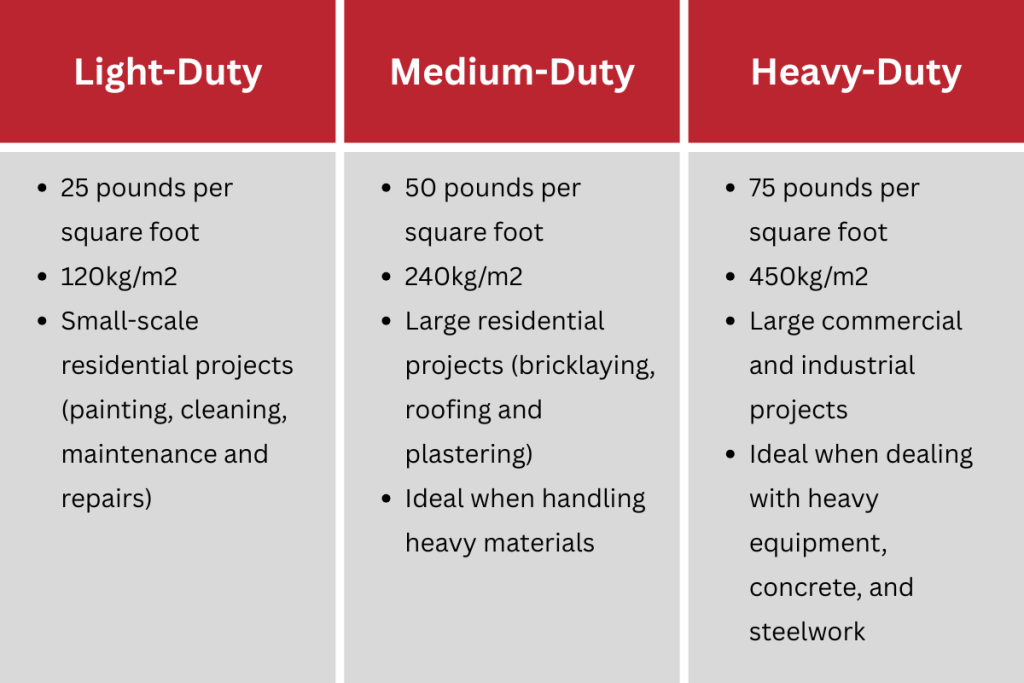
The Occupational Safety and Health Administration (OSHA) have established three classifications for scaffolding:
- Light-Duty: 25 pounds per square foot (or 120kg/qm2). Light-duty systems, such as mobile scaffold towers, are primarily used on small-scale residential jobs and maintenance tasks. Types of jobs include painting, cleaning, window installation, and repairs. It is ideal for situations where a platform is only supporting a single worker, their tools, and/or lightweight materials.
- Medium-Duty: 50 pounds per square foot (or 240kg/m2). Medium-duty systems are ideal for larger residential projects and work, such as bricklaying, roofing, plastering, and other tasks requiring heavier materials.
- Heavy-Duty: 75 pounds per square foot (or 450kg/m2). Heavy-duty systems are ideal for commercial and industrial projects involving heavy equipment, concrete, and steelwork. Failing to adhere to these classifications will result in structural instability and collapse.
Types of Scaffold Loads
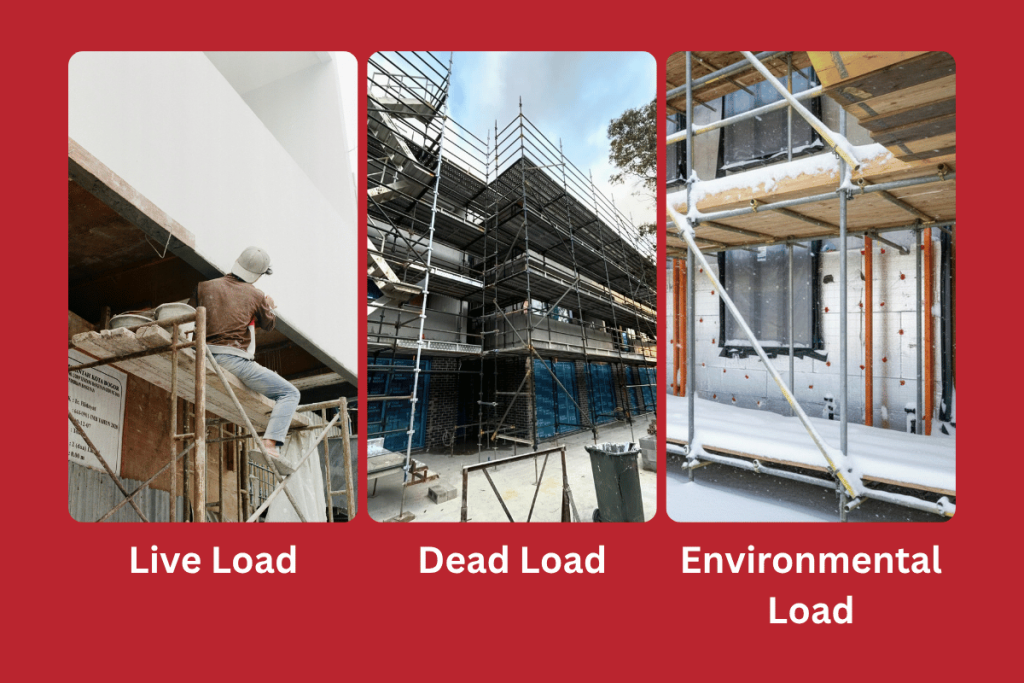
It is vital to consider these three primary types of loads when assessing a scaffold’s load limit
- Live Loads: People, tools and materials that move over the course of the project. Additional forces act on the scaffold when people or objects are moving. If the structure does not have the correct load rating, the entire system could become unstable and fail.
- Dead Loads: The permanent weight of a building or structure (in this case, the scaffold itself).
- Environmental Loads: Forces applied by environmental factors, and only a factor for outdoor scaffolds. They do not fall under live or dead loads, as some forces may act laterally on the structure instead of vertically. Environmental loads include wind, rain, snow, and more.
Calculating a Scaffold’s Load Capacity
When establishing the load limit of a scaffold, it’s important to consider the design of the scaffold itself, the materials used, and how it was constructed.
Determining the total capacity can be done in multiple ways:
- Check manufacturer instructions: Load ratings are usually included in the official manual or specification sheet. Manufacturers and suppliers can also provide test reports and certificates if required.
- Calculate based on square feet: Multiply the load classification by the platform area in square feet.
- Hire a professional: The safest way to establish load capacity is to hire a scaffold engineer for large scale commercial and industrial projects.
Overloading: Common Mistakes & How to Check for it
To ensure the stability and safety of the scaffold, it is crucial that the structure is not overloaded with materials and workers. Common causes for overloading include placing tools/materials in one spot, continued use of damaged components, and altering/adding platforms and ladders that are not rated or properly checked.
A common approach scaffolders use to check for overloading is the deflection method, which states that platforms should not deflect more than 1/60 of the span when loaded. For example, if a platform has a 10 ft span, it should not deflect more than 2 inches.
Overloading can also be avoided by following the load limits set by qualified scaffolders and manufacturer guidelines.
Maximum Intended Load (MIL)
The maximum intended load applies to any scaffold assembled. The OSHA 29 CFR 1926 report states that any bay must support its own weight and at least four times the intended load. The MIL varies depending on the laid classification of the scaffold itself and the type of loads that will be exerted on the structure. The MIL is a buffer to ensure that a scaffold won’t immediately fail if overloaded, and provides workers time to rectify the issue.
The MIL was not devised in a single day. Like all workplace safety standards and regulations, it was written in blood. According to recent statistics from OSHA, there are approximately 80 deaths annually from scaffold accidents in the US, accounting for almost 10% of all construction-related deaths in the industry. These figures show why it’s important that builders and scaffolders adhere to the strict guidelines.

Lynn Martelli is an editor at Readability. She received her MFA in Creative Writing from Antioch University and has worked as an editor for over 10 years. Lynn has edited a wide variety of books, including fiction, non-fiction, memoirs, and more. In her free time, Lynn enjoys reading, writing, and spending time with her family and friends.