
Most travelers check visa rules before a trip. Almost nobody checks phone registration rules, and in a growing list of countries that oversight now costs more than the flight. Turkey charges 54,258 Turkish lira, about 1,263 US dollars, to register a foreign phone, and an unregistered device is blocked from every Turkish network. Kyrgyzstan photographs SIM buyers at the counter and records the phone’s serial number before a tourist SIM will activate. Azerbaijan gives visitors 30 days. Nepal gives 15. These systems are spreading across Asia and the Caucasus, the fees rise every January, and the travelers who learn about them at an airport counter learn too late.
What IMEI registration actually is
Every mobile phone carries an IMEI, a fifteen digit serial number unique to the device. You can see yours by dialling star hash zero six hash. A growing number of countries now run national IMEI registries, and their networks check that number against the registry before letting a device connect. Register the phone and it works. Skip the registration and the network eventually refuses it, no matter which SIM card is inside.
The rules were written for smuggling and handset taxes, not for tourists, which is why they catch visitors by surprise. They are enforced automatically at the network level, so there is no official to reason with. And critically, they apply to the device rather than to the person, so buying a new local SIM card does not reset anything.
Turkey: 120 days, then a four figure bill
Turkey runs the strictest regime a tourist is likely to meet. A foreign phone works freely on Turkish networks for 120 days, counted from the moment a Turkish SIM card first connects. After that the device is blocked across all three national operators unless the owner registers it and pays the fee. For 2026 that fee was set at 54,258 lira, roughly 1,263 dollars, an 18.95 percent increase on the 45,614 lira charged during 2025. The block is permanent, and the 120 day counter continues across separate visits, so a traveler who spends three weeks in Istanbul every quarter is quietly running down the same clock.
Turkey’s 2026 fee, as reported by Turkiye Today on 1 January 2026.
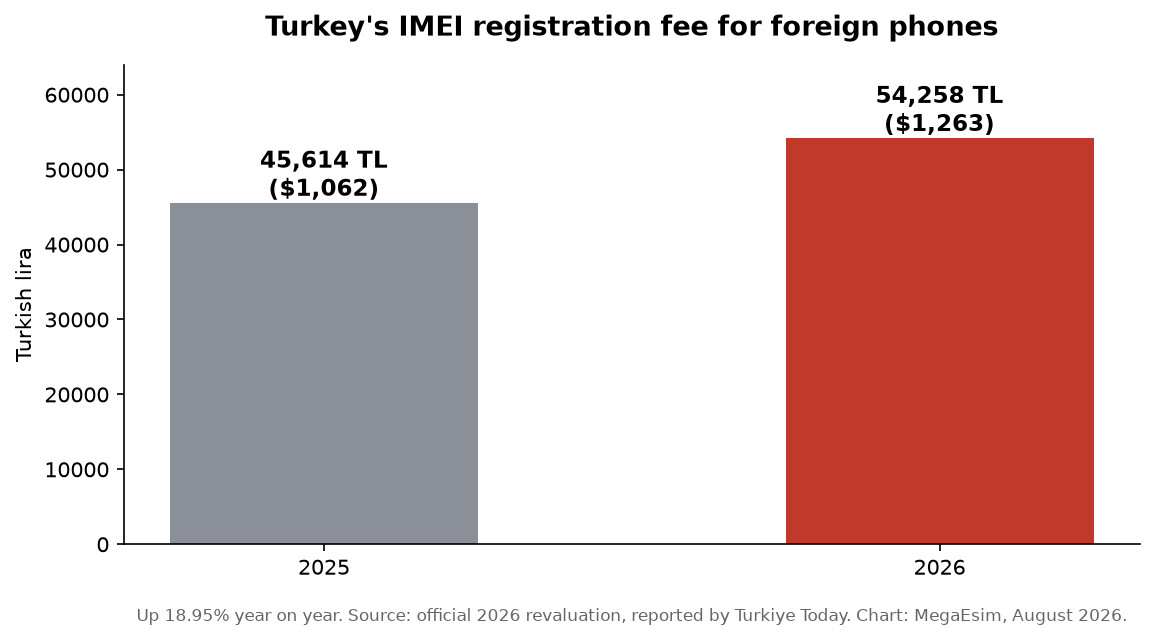
The fee is indexed to Turkey’s annual revaluation rate, so it rises every January.
Short holidays never reach the limit. The people it hits are the ones who least expect it: remote workers on long stays, property hunters, students, and families who return to the same coast every summer with the same phone.
Kyrgyzstan: no clock, because registration happens first
Kyrgyzstan takes the opposite approach. There is no grace period, because nothing is granted before registration. Buying a local SIM in Bishkek means handing over a passport, being photographed by the clerk, and having the phone’s IMEI recorded with the operator before the SIM will activate. Travelers on the country’s Reddit community describe the identical routine at Manas Airport kiosks and at city shops, and unregistered devices can have mobile data cut off by the network.
For a visitor landing at four in the morning, which is when a lot of flights reach Bishkek, that means paperwork at a kiosk before a ride can be booked into the city. Practical detail on how this plays out, including current local operator prices, is collected in MegaEsim’s guide to staying connected in Kyrgyzstan.
The wider wave: Azerbaijan, Pakistan, Nepal
Turkey and Kyrgyzstan are the strictest, not the only ones. Azerbaijan requires registration within 30 days of a device first connecting to a local network, with a fee scaled to the phone’s value, from 30 manat for a cheap handset up to 150 manat for anything over a thousand dollars. Pakistan’s DIRBS system allows 60 days before an unregistered phone is blocked, though the regulator has introduced free temporary registration for travelers and overseas nationals. Nepal’s Mobile Device Management System asks foreign visitors staying beyond 15 days to register their phones with passport and travel details.
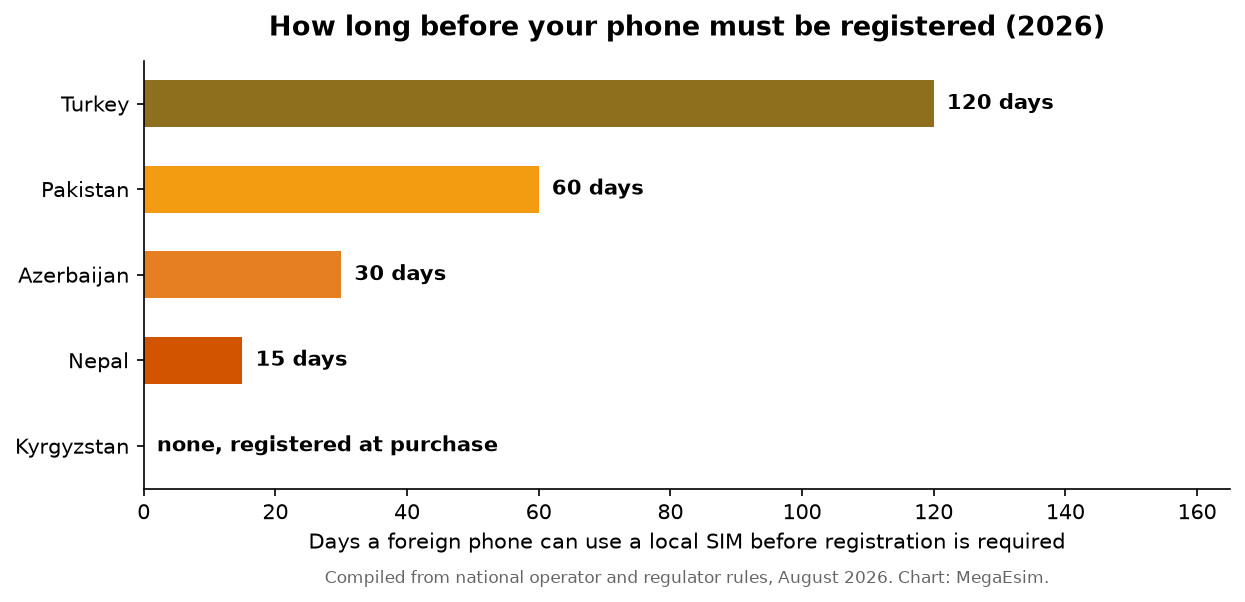
Grace periods vary from zero to 120 days across the region.
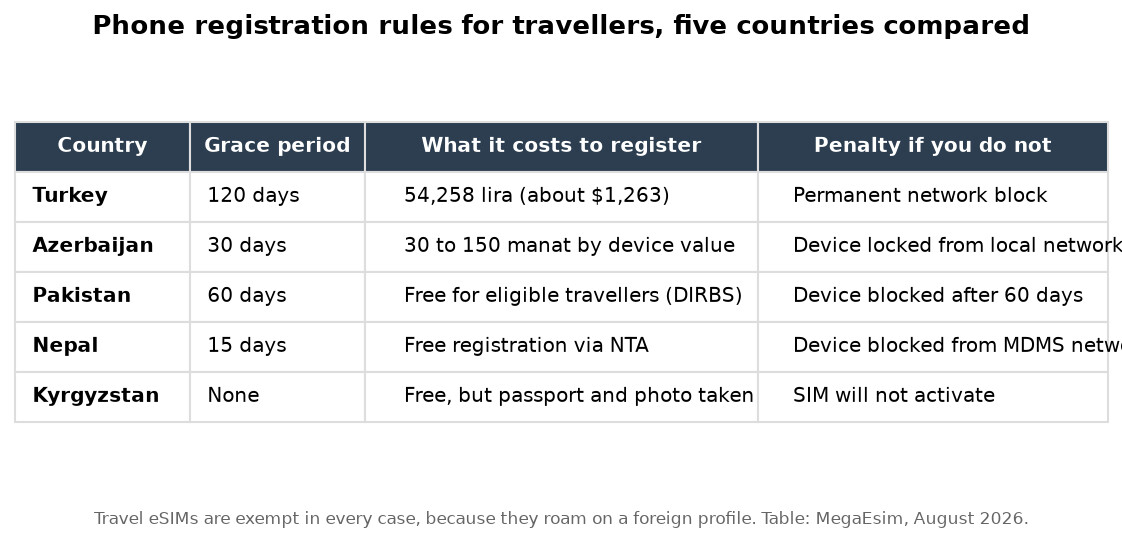
The five regimes side by side.
The exemption almost nobody mentions
There is one category of connectivity that sits outside all of these systems, and the confirmation comes from the operators themselves rather than from marketing. Azerbaijani operator Bakcell states the rule plainly on its own IMEI page: a foreigner using international roaming through a foreign operator’s SIM does not need to register the device at all.

Azerbaijani operator Bakcell confirms the roaming exemption on its official IMEI page.
That single sentence explains why travel eSIMs escape the registries. An eSIM bought abroad is a foreign profile roaming on the local network, not a local SIM subscription, so it never starts Turkey’s 120 day clock, never triggers the counter registration in Bishkek, and never appears in Azerbaijan’s device registry. The phone stays outside the system because, as far as the local network is concerned, it belongs to a visitor who is roaming. Travel eSIM provider MegaEsim, which tracks connectivity rules and retail data prices across 189 countries, reports that this exemption is now one of the more common reasons long stay travelers move off local SIM cards entirely. The equivalent breakdown for Turkey is in the same company’s explainer on Turkey’s 120 day device rule.
The exemption has limits worth stating honestly. A roaming profile gives no local phone number, which matters for anyone who needs local calls, deliveries or bank verification codes. And per gigabyte, a registered local SIM is usually still the cheapest data in these countries. The trade is convenience and legal simplicity against raw price.
The numbers to keep in mind for 2026
- Turkey: 120 day grace period, then 54,258 lira (about 1,263 dollars) to register, up 18.95 percent on 2025
- Azerbaijan: 30 days, fee scaled by device value from 30 to 150 manat
- Pakistan: 60 days under DIRBS, free temporary registration available to travelers
- Nepal: 15 days before MDMS registration is required
- Kyrgyzstan: no grace period, passport and photo taken at the counter
- Every one of these regimes exempts devices roaming on a foreign operator profile
Quick answers
Does this apply if I only use WiFi? No. The registries are triggered by connecting to a mobile network with a local SIM. A phone used purely on WiFi never enters the system.
Does buying a second local SIM reset the clock? No. Turkey’s counter is tied to the device IMEI, not to the SIM card, so a new SIM in the same phone changes nothing.
What happens to a blocked phone? It loses mobile service on that country’s networks. WiFi still works, and the device functions normally once you leave the country, which is why many travelers only discover the block on a return visit.
Is a travel eSIM legal in these countries? Yes. It is ordinary international roaming, the same mechanism your home carrier uses abroad, and operators publish the exemption themselves.
How do I check my IMEI before travelling? Dial star hash zero six hash on the phone. The fifteen digit number that appears is what every one of these registries records.
The registration wave is not slowing down. Fees indexed to inflation climb every year, enforcement is fully automated, and more countries in the region are studying the same model. For travelers the lesson is cheap and simple: check the rule before you land, and decide how you will stay connected before an airport counter decides for you.

Lynn Martelli is an editor at Readability. She received her MFA in Creative Writing from Antioch University and has worked as an editor for over 10 years. Lynn has edited a wide variety of books, including fiction, non-fiction, memoirs, and more. In her free time, Lynn enjoys reading, writing, and spending time with her family and friends.