


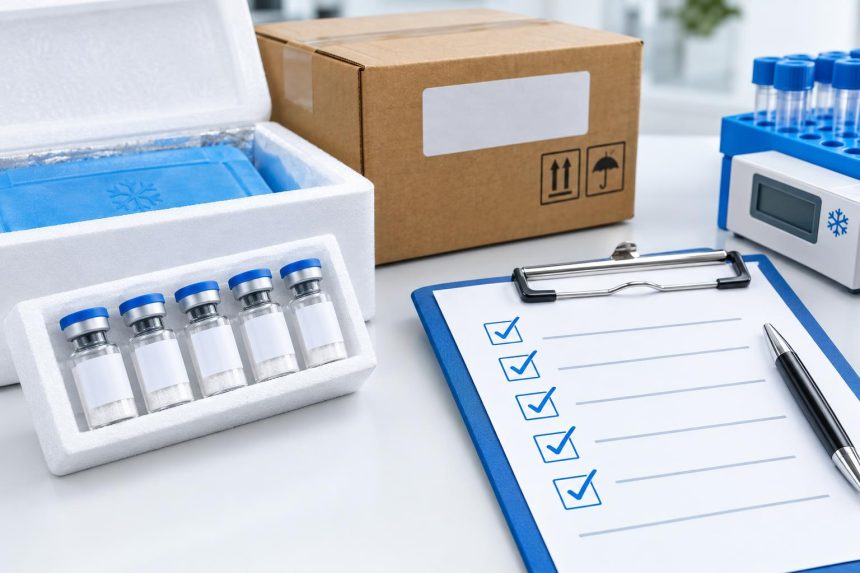
Checks made in the first hour after a peptide order arrives can catch errors early. Identity and condition get confirmed at the receiving bench, or errors can slip through and surface weeks later in the data. A short, repeatable checklist keeps that first hour consistent no matter who signs for the box.
Assign one person to own the delivery
When a shipment can be signed for by whoever happens to walk past, nobody is accountable for what happens next. Name a receiver for each expected order, and give that person the purchase record before the box lands. If the receiver knows what was ordered, in what quantity, and in what format, every later check takes minutes. If they don’t, the same checks turn into guesswork.
Labs that order premium research peptides on a regular cycle do better with a standing rotation than with ad hoc handoffs. When the same one or two people see every delivery, unusual packaging or a missing document gets noticed quickly.
Match identifiers before anything goes into storage
Before a vial leaves the bench, the purchase order, the packing slip, and the vial labels should agree. Check the compound name, quantity, and unit size on each one, and count the vials against the slip rather than against memory. The lot number on the slip should match the vials, and the purchase order’s too when it specifies one.
If any field disagrees, stop there.
A mismatch between the slip and the label is a question for the supplier to answer. Photograph the discrepancy while the packaging is still on the bench. Once the box is broken down, that record is much harder to assemble.
Partial shipments deserve the same discipline. If two vials arrive against an order for five, record the shortfall on the day it happens. A gap noticed a month later is much harder to resolve.
Record the arrival condition
Write down how the shipment looked when it arrived, not how it looked after an hour at room temperature. Note the state of the outer box, the inner packaging, and any cooling medium the supplier used. Some peptides ship frozen and others ship at ambient temperature with stability data behind that choice, so the goal is an accurate record of what the supplier sent and how it arrived.
If the box is crushed, wet, opened, or resealed, photograph it before the contents move. Carriers and suppliers both ask for that evidence, and it disappears quickly once vials are relocated. Give the record a timestamp and a permanent home while the details are fresh.
Inspect the vials without overreading them
Check each vial for an intact seal and a legible label. For freeze-dried peptides, the lyophilized cake should look dry and undisturbed; a collapsed or damp-looking cake is worth flagging to the supplier, because moisture exposure is a common cause of peptide degradation in storage. What a visual check can’t do is confirm purity or identity.
Labels deserve a close look on their own. The catalog number and lot number on the vial should match the paperwork exactly, and a smudged entry or a handwritten correction is a reason to pause.
Treat appearance as a screening step, not a verdict. Anything that looks wrong goes into a clearly marked quarantine spot until the supplier responds, and it stays out of circulation in the meantime.
Reconcile the lot documents
Every vial should trace back to a Certificate of Analysis for its lot, with purity measured by HPLC and identity confirmed by mass spectrometry. Compare the lot number on each vial against the lot number on the certificate, then file the certificate where the project team can actually find it. That file matters months later, when a result looks odd and the first question is which lot produced it.
Researchers who order through https://peptidelabs.us/ can run the same lot-number comparison on arrival. The check takes seconds, and it completes the trace from order to certificate.
Log storage against the product’s own instructions
Stability varies by sequence, a point manufacturer guidance from suppliers such as Sigma-Aldrich makes clear, so the product datasheet is the authority on temperature. Record where each vial went: which unit, which box, and the date it was placed.
Moisture control belongs in the same log entry. Keep vials in a sealed secondary container with fresh desiccant, and write the practice down once so it becomes the default for every order that follows.
Hand over to the project team
The last step on receiving day is a handover. Tell the project team what arrived, where it sits, and where the documents live. If anything was quarantined or queried with the supplier, that status belongs in the same note, so nobody reaches for a vial that is still in question.
A short message with the lot numbers and storage locations is enough. Custody moves from receiver to team with the paperwork attached, and the next person in the chain inherits a complete record.
None of this takes long. Half an hour of attention on receiving day protects months of work downstream and makes every later question about a result easy to answer.

Lynn Martelli is an editor at Readability. She received her MFA in Creative Writing from Antioch University and has worked as an editor for over 10 years. Lynn has edited a wide variety of books, including fiction, non-fiction, memoirs, and more. In her free time, Lynn enjoys reading, writing, and spending time with her family and friends.