Jeremy Orgel is a Board-certified psychiatrist based in The Woodlands and Shenandoah, Texas, where he serves as president of a private outpatient psychiatric practice and as a staff psychiatrist with Woodlands Internists. In addition to his clinical responsibilities, Jeremy Orgel maintains a long-standing personal interest in birdwatching, hiking, and outdoor observation. His decades of professional experience working with adolescents and adults, including leadership roles at the McAuley Neuropsychiatric Institute at St. Mary’s Medical Center in San Francisco, reflect a sustained commitment to careful attention and thoughtful analysis. Those same habits of observation inform his appreciation for noticing patterns in natural settings. With formal training from the University of California, San Francisco, and academic degrees from Columbia University and New York University School of Medicine, Dr. Orgel brings both professional discipline and personal enthusiasm to understanding how hikers can better recognize signs of active bird habitats along the trail.
Ways to Spot Active Bird Habitat Signs on a Hike
Whether the trail leads through a local park or a forest preserve, many hikers pass through bird activity without realizing what they are seeing or hearing. Bird habitats occur beyond wilderness; they exist right beside the path. Recognizing signs of an active habitat makes a routine walk interactive and does not require special gear.
In this context, “habitat” refers to the place that provides what birds need to eat, reproduce, avoid predators, and survive. Different habitats support different birds, and seasonal changes affect what birds do within those habitats. An “active” bird habitat is a space birds are currently using in observable ways, such as calling, moving through cover, or feeding.
One of the clearest signals is the overall habitat type, because habitat strongly shapes which birds are present. Common categories include woodland with tree cover, aquatic with water and shorelines, scrub-shrub with short woody growth, and open habitats such as fields or grasslands. When a trail passes from one category to another, the mix of birds likely to be noticed changes.
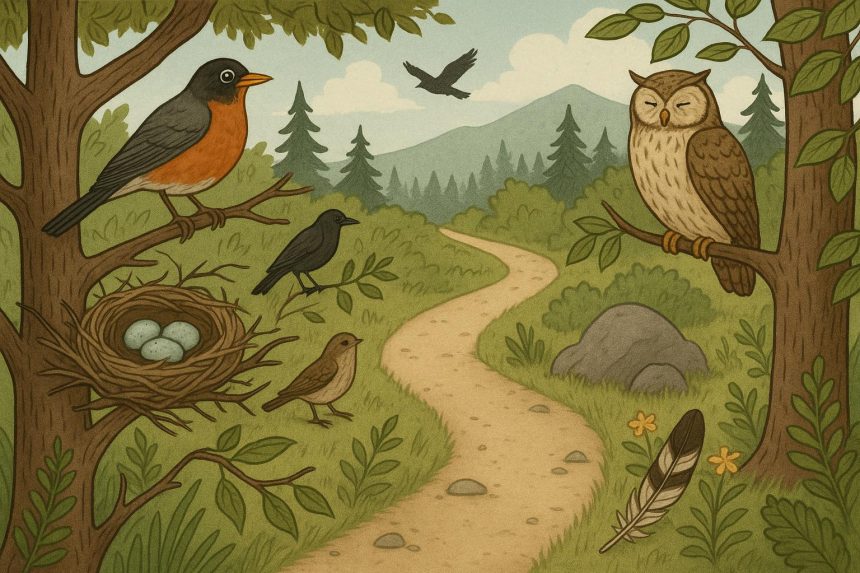
Within those habitat types, certain features draw attention during observation. In wooded areas, birding guidance commonly emphasizes looking into trees, including exposed perches such as treetops and poles. References also note that raptors, including hawks, owls, and eagles, use high perches. In aquatic settings, rivers, lakes, and wetlands can matter because many birds are associated with shorelines and wetland vegetation.
Behavior reveals bird presence before any individual bird comes into view. Songs and calls signal hidden birds when dense foliage or distance blocks a clear view. Because sound can be detected even when birds remain out of sight, listening registers bird presence across an area. Learning common songs and calls can connect a sound to a specific bird once the singer becomes visible.
Movement reinforces those auditory cues. Features such as silhouette, flight pattern, location, and behavior, along with size and visible markings, help narrow down what is present. Patient observation allows patterns to emerge, especially when a bird repeats a visible route or returns to the same spot.
Seasonal context also changes what “active” looks like in the same habitat. Birding guidance describes spring as a nesting season, summer as a period when adults hunt for food and watch over young, fall as a migration period, and winter as a season when ducks and geese can be common along waterways. These shifts can change what is heard and seen on familiar trails.
Nesting activity may occur even when nests remain hard to see, and nests take forms beyond a woven cup in a tree. Some birds, such as kingfishers, dig burrows, while woodpeckers create cavities by chiseling into trees. This variety shows why “nesting habitat” does not always include a visible nest along the path but can still show clear signs of active use.
Aquatic habitats provide a clear example of how habitat and behavior combine. Pied-billed Grebes inhabit freshwater marshes and lakes, spend much of their time diving, and often stay close to emergent vegetation, meaning plants such as cattails and bulrushes that grow up out of the water. References note that observers often scan ponds and small lakes with ample emergent vegetation and watch vegetated edges where birds may surface briefly before diving again.
As hikers build awareness of these cues, they sharpen their ability to notice changes across seasons and places. Over time, that attention turns birdwatching into a portable skill that applies on a forest trail, a neighborhood path, or a city park bench.
About Jeremy Orgel
Jeremy Orgel is a Board-certified psychiatrist serving adult and adolescent patients in Texas and California through private practice and telehealth. He joined Woodlands Internists as a staff psychiatrist in 2023, providing diagnostic evaluations and outpatient care. Earlier in his career, he spent 25 years at the McAuley Neuropsychiatric Institute at St. Mary’s Medical Center in San Francisco, including five years as Medical Director. Dr. Orgel completed his residency at the University of California, San Francisco, and holds degrees from Columbia University and the New York University School of Medicine.

Lynn Martelli is an editor at Readability. She received her MFA in Creative Writing from Antioch University and has worked as an editor for over 10 years. Lynn has edited a wide variety of books, including fiction, non-fiction, memoirs, and more. In her free time, Lynn enjoys reading, writing, and spending time with her family and friends.