



Gartner has identified AWS as a Leader in its 2026 Magic Quadrant for Strategic Cloud Platform Services for the 16th year straight. The cloud platform is known for a comprehensive ecosystem, a coherent approach to agentic AI, and an ability to work across several providers. Today’s companies are increasing their digital footprint and focusing on a multi-cloud environment. They need experts who can turn blueprints into reliable and cost-efficient systems. That is why the cloud architect demand is rapidly increasing.
The expectations from an architect have changed accordingly. The role is not about choosing an appropriate AWS service anymore. It also involves comparing options and creating a balance between performance, resilience, and cost.
This blog covers what drives this demand and the employer’s expectations. It also discusses how a certification and hands-on experience prove you can do the job.
Why Cloud Architect Demand Keeps Growing

Companies are actively recruiting people who can design an efficient cloud system, not just run it. Here is why AWS architect jobs are coming up more often:
Cloud Migration is a Business Decision Today
Before cloud adoption became a common phenomenon, it was considered an extended IT project. However, today it is a business goal that aims at lowering the operational risks. Every migration decision shapes how the next several years of your business look. Making a wrong choice can lead to a technical debt that’s difficult to recover from. That’s why companies want to recruit expert architects.
Modernisation Demands Design Judgement
Merely shifting an application to the cloud does not deliver all its benefits. That’s why companies are dividing large applications into smaller services through tools like containers, serverless computing, and managed databases. However, every approach comes with a compromise. An architect’s job is to choose the right approach that matches a business requirement.
Data and AI Workloads are Raising the Stakes
Data platforms and AI applications put excess demand on the infrastructure compared to traditional workloads. They require scalable storage, reliable pipelines, strict access controls, and proper governance over important data. When companies move from the experiment to the production stage, the architect is responsible for deciding whether the system is secure and dependable.
Cost Optimisation Has Become Paramount
Companies can quickly increase their cloud spend, but controlling it is what becomes difficult. Companies expect teams to show the value of every dollar and focus on cost optimization at every step. That’s why they need to choose the right resources and focus on cost governance.
Which AWS Skills Employers Expect When Hiring an Architect?

A cloud architect is expected to design, collaborate, monitor, and manage efficient solutions. Employers look for professionals who can confidently demonstrate these cloud architecture skills and make the right decisions:
Technical Knowledge
An architect should know how multiple aspects of AWS work together, including:
- Compute and storage include choosing the appropriate service to run applications and store data.
- Networking means setting up a secure system with Amazon VPC.
- Control who can access the information on AWS IAM and how to ensure data protection via encryption.
- Build systems that keep working even when something fails.
For an architect, it isn’t enough to know about the service. A company expects you to follow the AWS Well-Architected Framework (a checklist for an effective design).
Clear Communication
An architect is in touch with the developers, managers, clients, and stakeholders, and each of them is looking for a different answer. While handling the AWS job roles, an architect should be able to:
- Explain difficult designs in simple words.
- Showcase why one service is better than another.
- Illustrate through clear documents and examples.
- Understand business requirements and decide accordingly.
Cost Awareness
The design choices affect the monthly invoice. With an increase in data copies or servers, the bills continue to rise. Companies expect their AWS architect to manage the cost from the beginning and focus on:
- Choosing the best resource size for the workload.
- Using an appropriate pricing option.
- Set the budget and cost alerts.
No design decision is perfect. A quick system increases cost, while a safer one takes longer to build. Employers expect their architects to compare the pros and cons and decide wisely.
They also search for people who adapt to changes quickly. Digital transformation is real, and AWS continues to evolve, so yesterday’s decision might not be the best one today.
How the SAA-C03 Certification Proves These Skills
Understanding what AWS is is one thing; however, becoming an architect is entirely different. The AWS Certified Solutions Architect – Associate certification proves that you have the skills that it takes.
What Does a Certification Validate?
The AWS certification value is strong, as it confirms that you:
- Understand what the main AWS services are and how they work cohesively.
- Know how to create a balance between security, reliability, performance, and cost.
- Can choose under pressure and provide your company with the best solutions.
When hiring managers go through a myriad of resumes, the certification gives them a trusted signal. That’s why architects choose to earn the AWS Certified Solutions Architect – Associate, followed by the Professional level for more experienced candidates.
Where a Certification Falls Short?
An exam comes with certain limitations. Yes, it does validate your knowledge, but what about your confidence when a real situation comes up? You must also know how to handle a complex situation, a cross-functional collaboration, a bill that’s piling up, or a dataset that is yet to be secured.
Why Hands-On Skills Matter Equally?
Practical experience is what fills the gap. When you work on an actual system, you learn what the exam questions merely describe. You fix what’s breaking and learn which choices work the best. Here is what is useful:
- Practice hands-on labs and free-tier projects
- Cloud Sandbox for real-life simulation
Why Do the Two Work Best Together?
Certification → Theory
Hands-On Labs → Application
One without the other might not completely earn an employer’s confidence. But when combined, they can get a better idea of your expertise.
The right approach is to start a AWS SAA-C03 course that provides both theoretical and practical knowledge.
Key Steps to Build Your AWS Career
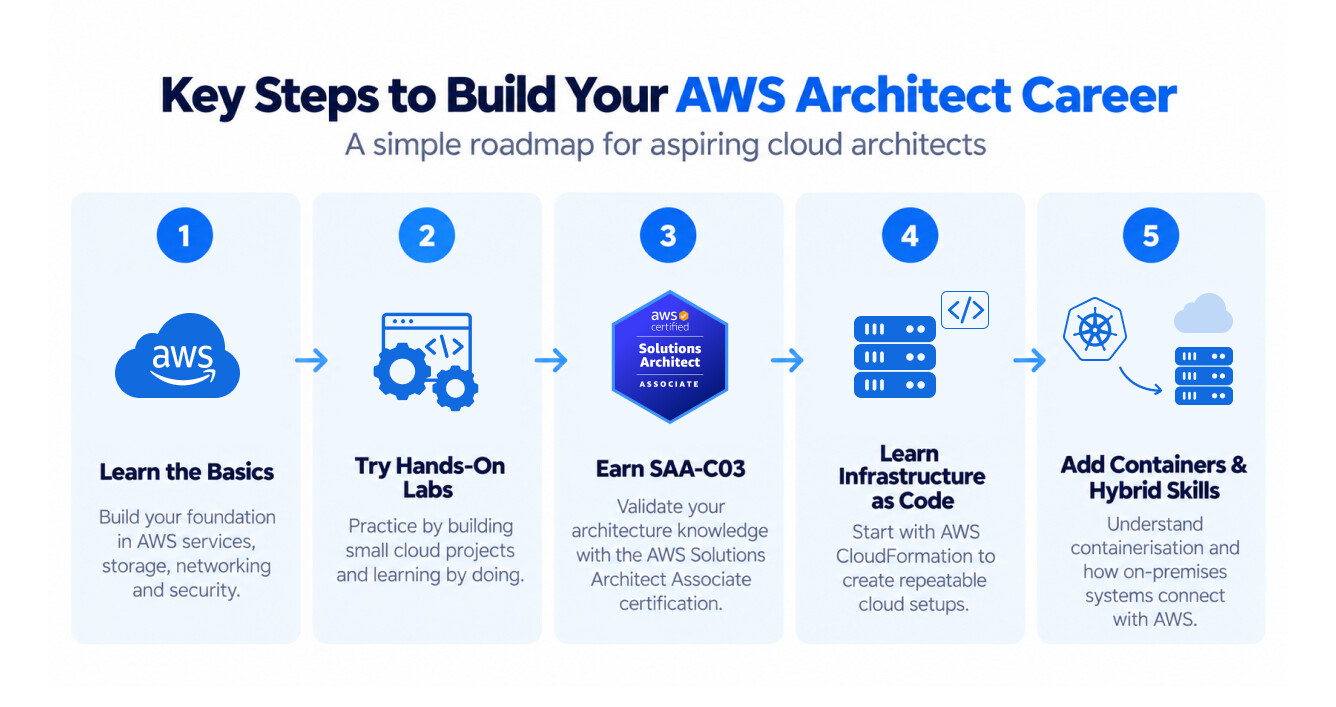
You might feel anxious if you are just beginning your cloud computing career. But here is a simple path to follow and make the journey smooth:
- Learn the Basics
Start by understanding AWS servers, storage, networks, and security. The official AWS Skill Builder platform offers free training to every candidate and learner.
- Try Hands-On Labs
Start practising on a demo site. You can try hosting a website or creating a basic app. One of the easiest ways to learn is by breaking and fixing things.
- Earn the SAA-C03 Certification
Once you are confident, enrol for the AWS Certified Solutions Architect – Associate certification exam. Meanwhile, attempt full-length practice tests to understand the kind of questions that will come.
- Learn Infrastructure as Code
Real teams use Infrastructure as Code, i.e., writing the setup as code that can be repeated and reviewed. Start your practice with AWS CloudFormation that lets you describe your servers, networks, and databases in a file and create them with one command.
- Pick Up Containers and Hybrid Skills
Several companies now use containerisation, i.e., packing an app and everything it requires into a single unit that runs the same way on every platform.
You can also learn the basics of a hybrid architecture to effectively divide the systems between the company’s data centre and AWS.
Conclusion
Cloud architect demand is increasing as businesses are moving extensively towards automation. They are running AI workloads and updating old systems to control cost. All of these processes require an expert who can design well.
An employer expert technical knowledge, communication skills, cost awareness, and proactive thinking from architects. But merely stating these qualities in a resume isn’t enough anymore. What you require is a certification that proves your knowledge and hands-on project experience that validates your skills.
Start small, keep building, and keep learning. The architects who do this will stay in demand for years to come.

Lynn Martelli is an editor at Readability. She received her MFA in Creative Writing from Antioch University and has worked as an editor for over 10 years. Lynn has edited a wide variety of books, including fiction, non-fiction, memoirs, and more. In her free time, Lynn enjoys reading, writing, and spending time with her family and friends.