Kids don’t learn in stiff, formal settings. What you’ll actually observe is that kids learn in small, informal ways, such as when they are using the bathroom, in the kitchen, or just observing what everybody else is doing around the house. These small activities may seem unimportant, but let’s face it, kids are doing a lot behind the scenes. These activities help your toddler feel good about themselves and promote independence in them. When you provide them with the right equipment, you’ll realize that learning is happening naturally and is not forced in any way.
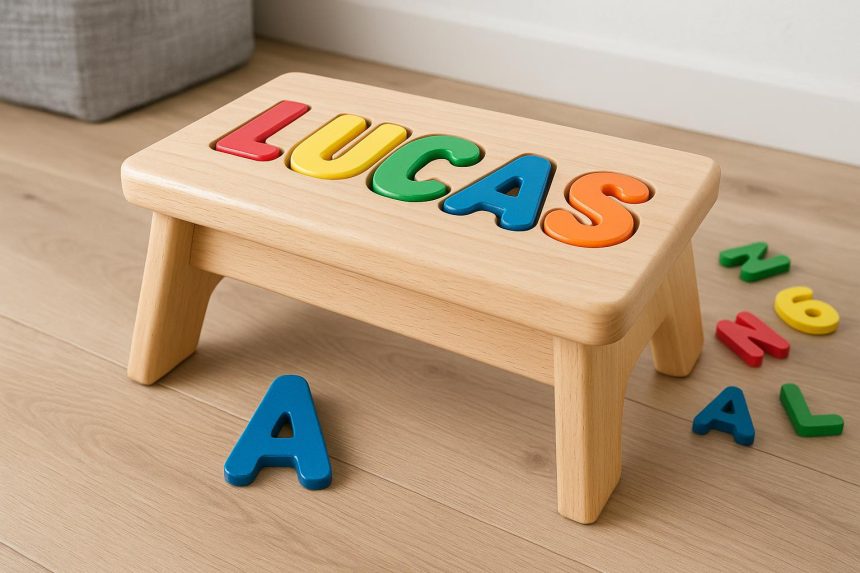
Let’s take an in-depth look at our step stool example. Your toddler doesn’t just use this tool once in their daily routine. It’s used in so many small ways: brushing their teeth, washing their hands, helping you cook, reaching the counter, or just when they want to know what’s going on around them. When your child’s step stool has their name built into the top and they are able to take out the puzzle letters and put them back in, this is more than just using a tool. It’s become an activity for them to return to, repeatedly. This is learning in their daily routine. He/She will repeatedly return to this interactive tool, which will quietly help them learn their letters. Parents typically see their children play and explore these types of tools for long periods of time. A well-designed stepping stool for kids that is personalized, can turn an ordinary routine into an opportunity for your child to repeatedly learn, without adding any extra learning time into your child’s daily routine.
Now, typically a personalized step stool has your kid’s name on it and a puzzle on top that lets them play with letters. This may seem like a small thing, but trust us, it’s quite powerful. Why does personalization work for kids in this age group? Well, kids are drawn to familiar things, and their name is probably the most familiar thing in the world to them. It’s probably one of the first words they recognize, and they spend a lot of time trying to say it and later read it. This is the age where anything associated with their name will capture their interest. In fact, research indicates that children will focus longer on learning if it’s associated with who they are. The interest sparked is not only good to have, it’s what they retain about what they’re learning. And, they don’t even realize it’s an “educational” thing because they’re having fun with something that’s their own.
Recognition Of A Child’s Name Is The First Pattern To Recognize Before Reading Full Words
Children learn to recognize patterns before they learn to read full words. Typically, a child’s name is the first recognizable pattern. When a toddler sees their name frequently:
- they begin to notice shapes of letters
- they begin to identify sequence
- they associate sounds to letters
With a puzzle-style name on the top of a step stool, each letter becomes something that your child can physically manipulate. Your child is not just viewing their name; they are picking it up, rotating it, placing it into position.
Over time, this will aid in developing the following:
- left-to-right sequence
- visual memory
- early phonics awareness
And since it relates to something personal, the experience typically feels less like practice and more like fun.
Developing Fine Motor Skills Using Play
As important as the emotional connection is, there’s also a physical component to developing fine motor skills. While working on a puzzle, using the pieces to solve the puzzle, rotating the pieces, etc., children strengthen the small muscles in their hands and fingers. The same muscles will be used later by your child to write, draw, and handle everyday objects. Some examples of how children use their hands and fingers to develop coordination and control include:
- holding a letter
- rotating it
- placing it in its correct position
- pressing it into the paper
These examples are a great representation of the relationship between everyday play and early childhood development. It’s interesting to see how early hand coordination develops as a result of repeated, hands-on activities. This is especially important early on, when developing motor skills for babies.
Independence Creates Self-Confidence
Another element of step stools that is unrelated to letters or puzzles; yet is still very relevant is independence. Children are self-motivated and want to accomplish tasks independently. Whether they have the physical capability or not, children attempt to complete tasks on their own. A step stool allows children to be involved in daily activities without requiring assistance constantly. This slight shift can create a large impact.
Children who are able to:
- climb onto the counter to wash their hands
- climb safely onto a stool to reach a cabinet
- participate in daily routines
generally feel more confident. When a stool includes the child’s name, it creates a further sense of ownership. It’s not just any stool. It’s theirs.
Learning Without Struggle
Another advantage of products such as this is that parents are not required to put additional effort into providing opportunities for learning. There is no need to:
- schedule special learning time
- provide structured lessons
- directly supervise each interaction
Learning occurs organically through repetition. Your child may climb up to get a book off the shelf. They notice a letter. They remove the letter. They replace it. Perhaps they say the letter aloud. Perhaps they don’t. Regardless of whether they state the letter or not, they are exposed. As time passes, the cumulative effect of numerous, similar exposures will ultimately contribute to your child’s learning.
Why Materials and Design Matter
All step stools are not created equally. Since a product that is used by a toddler several times per day needs to be both safe and long-lasting, the materials and design of a step stool is crucial. In addition to safety concerns, parents typically consider other factors including:
- construction made of solid wood
- non-toxic coatings
- a stable, tip-proof design
- smooth edges and sturdy components
A well-designed step stool provides not only an opportunity for learning, but also serves as a piece of equipment that will provide consistency and reliability to your child’s environment.
A Simple Tool With Long-Term Effects
It is easy to overlook how much learning occurs in everyday, non-academic types of situations. Much of the learning that occurs in everyday life does not resemble learning at all. Learning occurs in the following types of situations:
- Climbing
- Reaching
- Playing
- repetition
However, that is precisely the manner in which young children develop their understanding of the world. When an item as basic as a step stool is developed to provide opportunities for interaction, personalization and mobility, the tool transforms from being merely functional into a component of the child’s learning environment. And occasionally, the moments that matter most are the ones where we least expect them.

Lynn Martelli is an editor at Readability. She received her MFA in Creative Writing from Antioch University and has worked as an editor for over 10 years. Lynn has edited a wide variety of books, including fiction, non-fiction, memoirs, and more. In her free time, Lynn enjoys reading, writing, and spending time with her family and friends.