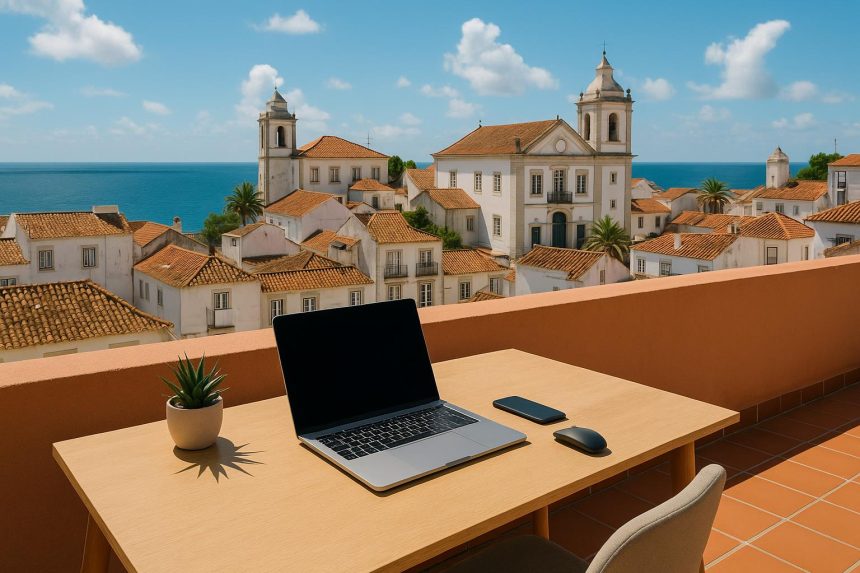
Portugal has become one of Europe’s most established destinations for remote workers, but the shift goes far beyond lifestyle appeal. A new rental ecosystem is emerging, designed specifically for digital nomads, remote professionals, and long-stay international tenants who require more than traditional holiday accommodation.
This evolution is reshaping how housing is developed, rented, and managed across Lisbon, Porto, and increasingly, the Algarve. What is emerging is not a temporary rental trend, but a structural adjustment in how residential property is used.
The Rise of Remote Work as a Structural Demand
Remote work is no longer an exception within European labour markets. It has become a stable and widely adopted employment model across multiple sectors.
According to Eurostat, a significant proportion of workers across the European Union now operate under hybrid or fully remote arrangements, with Portugal consistently recording strong adoption levels compared to Southern European peers.
This shift has direct implications for housing demand. Location is no longer defined by proximity to offices. Instead, it is shaped by connectivity, liveability, and suitability for long-term use. Housing decisions are increasingly decoupled from traditional commuting requirements.
Portugal’s Changing Population and Mobility Patterns
Alongside the growth of remote work, Portugal has also experienced measurable changes in migration and mobility patterns.
Data from the Instituto Nacional de Estatística highlights continued inflows of international residents, particularly EU citizens and non-EU professionals relocating for lifestyle and remote work opportunities.
This combination of inward migration and remote employment has created a new tenant profile. These renters are typically long-stay, income-stable, and digitally connected. Their expectations differ significantly from short-term holiday visitors.
From Holiday Lets to Digital Nomad Housing
Traditional short-term rental models in Portugal were built around seasonal tourism cycles. Digital nomads, however, operate on entirely different timelines and requirements.
Their stays typically range from one to twelve months, often outside peak tourist seasons. They require stable internet, dedicated workspaces, and housing that supports daily routines rather than temporary stays.
This has led to the emergence of a more defined housing segment:
Co-living spaces
Shared residential environments designed to combine affordability, social interaction, and networking opportunities for remote workers.
Hybrid rental apartments
Private units supported by shared amenities such as coworking areas, gyms, and communal lounges.
Purpose-built remote work housing
Developments designed specifically for long-stay tenants, integrating high-speed internet, ergonomic layouts, and flexible lease structures.
In coastal regions where demand is strongest, this segment increasingly overlaps with traditional tourism markets such as algarve holiday rentals, although usage patterns are now shifting toward longer occupancy cycles rather than seasonal turnover.
Why Portugal Is a Strong Hub for Digital Nomad Housing
Portugal’s position as a remote work destination is supported by structural advantages rather than short-term market dynamics.
Reliable digital infrastructure
Fibre broadband coverage has expanded significantly across urban and coastal areas, enabling stable remote work even outside major city centres.
Cost and lifestyle balance
Compared to many Western European countries, Portugal continues to offer relatively competitive living costs while maintaining high standards of healthcare, safety, and infrastructure.
Climate and livability
Mild weather conditions support outdoor living throughout much of the year, reinforcing the appeal of flexible, location-independent work lifestyles.
These factors combine to create a stable foundation for long-stay rental demand.
The Algarve’s Emerging Role
While Lisbon and Porto initially led Portugal’s digital nomad expansion, the Algarve is increasingly positioning itself as a secondary hub.
Towns such as Lagos, Faro, and Portimão are experiencing rising demand for long-stay furnished properties, particularly those offering reliable connectivity and walkable access to town centres and coastal amenities.
Unlike traditional holiday accommodation, these properties are not purely seasonal. Many now operate on extended occupancy cycles, reflecting a shift in how space is being used throughout the year.
This transition is gradually influencing broader rental patterns across southern Portugal.
Infrastructure Driving the Market Shift
The expansion of digital nomad rentals depends on more than demand. It requires supporting infrastructure that enables sustained remote living.
Key elements include:
- High-speed, stable internet as a baseline requirement
- Flexible rental regulations supporting medium-term leases
- Integration of co-working spaces within residential environments
- Transport systems designed for occasional travel rather than daily commuting
As a result, developers and landlords are increasingly repositioning assets away from short-term tourism reliance and toward hybrid residential models that can accommodate multiple occupancy types.
Economic Impact on the Rental Market
This structural shift is influencing rental markets in several measurable ways.
Seasonality in coastal regions is gradually reducing as long-stay tenants extend occupancy beyond traditional peak periods. This creates more stable year-round demand compared to tourism-driven cycles.
Properties that are fully equipped for remote work are also experiencing higher occupancy consistency. Demand is increasingly concentrated in well-designed, internet-ready apartments rather than generic short-term units.
At the same time, pricing resilience is improving in locations aligned with remote work demand. This reflects a broader shift from seasonal volatility toward more predictable rental income patterns.
What This Means for Landlords and Investors
For property owners in Portugal, particularly in high-demand coastal regions such as the Algarve, the rental strategy is evolving.
Instead of relying exclusively on short-term tourism, many landlords are now considering:
- Medium-term furnished rentals ranging from three to twelve months
- Properties designed specifically for remote workers
- Flexible pricing structures based on occupancy duration rather than seasonality
In this context, well-positioned units that support remote working conditions are increasingly outperforming traditional holiday-only properties. The focus is shifting toward usability, connectivity, and long-stay functionality rather than peak seasonal occupancy alone.
Conclusion
Portugal’s digital nomad rental market is no longer a niche segment. It has become part of a broader structural transformation in how housing is used across the country.
Supported by mobility data from the Instituto Nacional de Estatística and remote work trends tracked by Eurostat, Portugal is moving toward a hybrid residential model that blends living, working, and long-term flexibility.
In this environment, rental performance is increasingly determined by infrastructure rather than seasonality. Properties that support remote work lifestyles are gaining relevance, while traditional short-term models are being repositioned within a more diversified rental ecosystem.
As this shift continues, the most competitive assets will be those that combine connectivity, functionality, and adaptability to long-stay demand patterns across Portugal’s evolving property landscape.

Lynn Martelli is an editor at Readability. She received her MFA in Creative Writing from Antioch University and has worked as an editor for over 10 years. Lynn has edited a wide variety of books, including fiction, non-fiction, memoirs, and more. In her free time, Lynn enjoys reading, writing, and spending time with her family and friends.