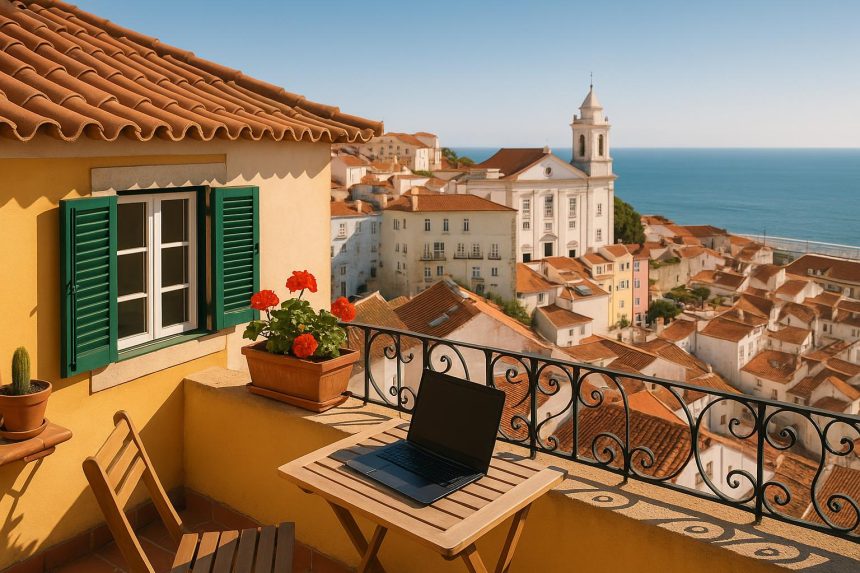
Portugal’s housing market is undergoing a quiet but structural redesign. Homes are no longer being planned purely as places to live or occasional holiday assets. Instead, they are increasingly shaped around hybrid living, where work, rest, and travel exist within the same residential space.
This shift reflects a broader change in how people organise their lives. Driven by remote work adoption, longer stays, and more flexible mobility patterns, the traditional separation between home and workplace is gradually weakening.
From Traditional Homes to Hybrid Living Spaces
The traditional residential model in Portugal assumed a clear separation: people left home to work and returned at the end of the day to rest. That structure is becoming less dominant.
Today’s buyers and tenants expect homes that support multiple functions at once. This includes dedicated work areas, stable internet connectivity, and adaptable living environments that can shift between professional and personal use.
Key expectations now include:
- Dedicated home office or flexible work zones
- Reliable high-speed internet infrastructure
- Quiet areas for rest and recovery
- Indoor-outdoor living spaces with year-round usability
- Multi-purpose rooms for long stays or guests
This transformation is most visible in Lisbon, Porto, and the Algarve, where international demand and remote work lifestyles are influencing design expectations and property use patterns.
The Data Behind the Shift
The rise of hybrid living is supported by clear labour and mobility trends across Europe.
According to the Instituto Nacional de Estatística, remote and hybrid work arrangements have increased significantly in Portugal in recent years. This has directly influenced commuting behaviour and housing preferences, with more people prioritising flexibility over proximity to physical workplaces.
At a European level, Eurostat data confirms sustained growth in teleworking across EU member states. Portugal consistently appears among the Southern European countries with higher levels of remote work adoption.
Together, these trends indicate a structural change rather than a temporary adjustment. Housing demand is increasingly shaped by how people work, not just where they work.
How Homes Are Being Redefined
The “hybrid home” is not a fixed architectural model. It is a design response to changing lifestyle behaviour. Instead of focusing only on bedrooms and location, properties are now built around flexibility and usability.
1. Work-integrated living spaces
Homes are being designed with adaptable rooms that can function as offices, study areas, or quiet work environments depending on daily needs.
2. Wellness-focused design
Natural light, ventilation, terraces, and quiet zones are becoming essential components rather than optional extras.
3. Leisure integration
Outdoor dining areas, pools, and shared communal zones are increasingly part of residential planning, supporting daily recreation within the home environment.
4. Travel-ready flexibility
Many properties are designed for intermittent occupancy, allowing owners to move between countries or work locations without disrupting their living arrangements.
This reflects a broader shift in how residential space is used, where the home functions as a base for multiple aspects of life rather than a single-purpose structure.
Market Signals and Buyer Behaviour
Property data and search behaviour reinforce this shift in demand.
According to Idealista trend analysis, there has been a clear increase in listings and searches across Portugal highlighting features such as home offices, terraces, and flexible layouts. This indicates that buyers are actively prioritising functional adaptability over traditional property characteristics alone.
This is particularly visible in coastal and urban markets, where international buyers and remote professionals are reshaping expectations for residential design and long-term usability.
In regions such as the Algarve, this is also reflected in demand for properties that support flexible living patterns, including interest in areas like buy property in vilamoura, where lifestyle, connectivity, and long-stay suitability increasingly overlap.
Why Portugal Is Leading the Hybrid Home Shift
Portugal is uniquely positioned for this transition due to a combination of structural and lifestyle factors.
1. Remote work adoption
Portugal has a strong base of remote and hybrid workers, supported by broader EU labour market changes.
2. International buyer influence
A significant portion of property demand comes from buyers not tied to local employment structures, increasing demand for flexible housing.
3. Climate advantages
Mild weather conditions allow for extended outdoor living, effectively expanding usable home space beyond interiors.
4. Regional diversity
From Lisbon apartments to Algarve villas, Portugal offers a wide range of housing types that can be adapted to hybrid living models.
These factors collectively support the growth of housing designed around flexibility rather than fixed usage patterns.
The Algarve as a Hybrid Living Region
The Algarve is one of the clearest examples of hybrid housing demand in practice.
Across towns such as Lagos, Faro, and Vilamoura, buyers increasingly prioritise:
- Quiet environments suitable for remote work
- Reliable fibre internet connectivity
- Outdoor terraces and private leisure space
- Access to airports and travel infrastructure
- Year-round usability rather than seasonal occupation
This reflects a broader change in how coastal property is being used. Homes are no longer viewed primarily as holiday assets but as flexible residential bases for international, mobile lifestyles.
Developer Response to Hybrid Demand
Developers across Portugal are adapting to this shift by integrating hybrid functionality into both new builds and refurbishments.
Common design changes include:
- Dedicated office spaces or multi-use rooms
- Co-working areas within residential complexes
- Shared wellness facilities such as gyms and yoga rooms
- Smart home systems for remote control and efficiency
- Energy-efficient and low-maintenance building design
The focus is increasingly on creating environments that support full daily cycles of work, living, and leisure within a single property setting.
Economic Impact on the Property Market
The hybrid home model is reshaping how value is defined in Portugal’s real estate market.
Properties with flexible layouts and strong digital infrastructure are experiencing stronger demand compared with traditional configurations. Lifestyle functionality is becoming a key pricing factor, alongside location and size.
At the same time, longer average stays are reducing reliance on seasonal rental cycles, particularly in coastal markets. This is contributing to more stable occupancy patterns and improved long-term demand consistency.
International buyers are also playing a role in raising expectations around design standards, particularly in areas with strong expat presence.
Conclusion
The hybrid home revolution in Portugal reflects a broader structural change in how people live and work. Homes are no longer defined by a single purpose. Instead, they are evolving into flexible environments that support work, wellbeing, and mobility within one space.
Supported by data from the Instituto Nacional de Estatística and Eurostat, and reinforced by market behaviour tracked by Idealista, this shift is clearly established rather than speculative.
Across Portugal, and especially in lifestyle-driven regions such as the Algarve, the home is increasingly becoming a multi-functional base for modern living. It is no longer just a place to stay. It is where work, travel, and daily life now operate as a single integrated system.

Lynn Martelli is an editor at Readability. She received her MFA in Creative Writing from Antioch University and has worked as an editor for over 10 years. Lynn has edited a wide variety of books, including fiction, non-fiction, memoirs, and more. In her free time, Lynn enjoys reading, writing, and spending time with her family and friends.