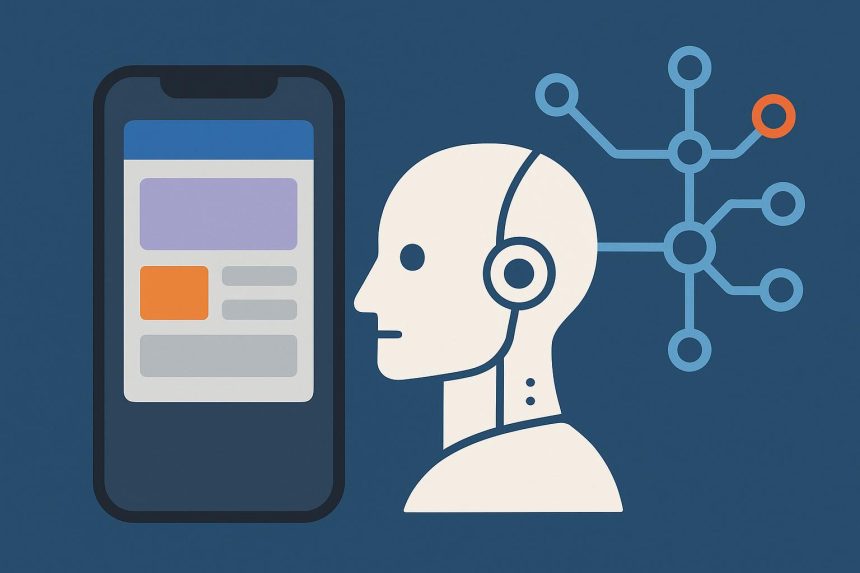
For decades, software applications were built around a simple assumption: humans would always be the primary users.
Developers designed interfaces to help people navigate menus, enter information, complete tasks, and access data. Whether it was a mobile banking app, a customer relationship management platform, or an enterprise dashboard, the success of the product largely depended on how efficiently users could interact with it.
Today, however, software teams, including those at an app development company in Dallas working on enterprise and AI-powered solutions, are beginning to encounter a different challenge: designing systems that can effectively serve both people and intelligent software agents.
That assumption is beginning to change.
This shift is making organizations rethink how applications are designed, how systems communicate, and what software architecture should look like in an AI-driven future.
What Makes AI Agents Different?
Automation is not new. Businesses have relied on rules-based automation for years to streamline repetitive tasks.
AI agents operate differently.
Instead of following fixed instructions, modern agents can interpret objectives, evaluate available information, determine appropriate actions, and adapt to changing circumstances. They can navigate workflows, interact with software tools, and coordinate tasks across systems.
Recent product launches demonstrate how quickly this technology is moving into mainstream business environments. Microsoft’s Copilot ecosystem, Salesforce’s Agentforce platform, ServiceNow’s AI agents, and Atlassian’s Rovo are all examples of organizations investing heavily in agent-driven workflows.
The growing adoption of these technologies signals an important reality: applications are no longer serving only human users.
The Human-Centered Design Model Is Expanding
Traditional application design focuses on optimizing user journeys.
A product team typically asks questions such as:
- How many clicks does it take to complete a task?
- Is navigation intuitive?
- Can users find information quickly?
- Is the interface visually clear?
These questions remain important, but they are no longer sufficient.
AI agents interact with software differently than humans. They do not care about menus, buttons, dashboards, or visual hierarchy. Their effectiveness depends on access to data, workflows, permissions, and application functionality.
As a result, organizations must increasingly design for two audiences:
- Human users
- AI agents
The challenge is not replacing one with the other. It is creating systems that support both effectively.
Why APIs Are Becoming More Important Than Interfaces
Many applications were historically built with interfaces as the primary interaction layer.
AI agents are changing that model.
Instead of navigating screens, agents typically interact with applications through APIs, integrations, and backend services. This means software capabilities must be accessible beyond the user interface.
Consider a sales manager seeking a quarterly performance report.
Traditionally, they might log into a dashboard, apply filters, export data, and generate a presentation.
An AI agent can potentially complete the same process automatically by accessing relevant systems, gathering information, identifying trends, and presenting recommendations.
In this environment, APIs become strategic assets rather than technical conveniences.
Organizations with well-documented and secure APIs are often better positioned to adopt AI-driven workflows than those relying heavily on manual user interactions.
Context Is Becoming the New Competitive Advantage
Much of the public discussion around AI focuses on prompts.
In reality, context is often more important.
An AI agent can only perform effectively when it has access to accurate, relevant, and timely information. Without sufficient context, even advanced models struggle to deliver reliable outcomes.
This is where many applications encounter challenges.
Enterprise data is frequently fragmented across multiple systems. Customer records may exist in one platform, operational data in another, and internal documentation somewhere else entirely.
For AI agents to operate effectively, applications must provide:
- Structured data environments
- Reliable knowledge sources
- Real-time information access
- Clear business rules
- Permission-based access controls
Organizations that improve contextual access will often achieve better AI outcomes than those focusing exclusively on model selection.
Security and Governance Are Moving to the Forefront
The introduction of AI agents creates new governance challenges.
Traditional security models assume actions are performed directly by authenticated users. AI agents introduce an additional layer between humans and systems.
Questions that product teams rarely considered a few years ago are becoming increasingly important:
- What actions should agents be allowed to perform?
- How should decisions be monitored?
- What level of autonomy is appropriate?
- How can organizations maintain accountability?
- How should sensitive data be protected?
According to industry analysts, governance and trust remain among the most significant barriers to large-scale AI adoption. As a result, organizations investing in AI development services are placing greater emphasis on security frameworks, permission controls, and audit mechanisms to ensure AI agents operate responsibly within enterprise environments.
Organizations that fail to establish clear controls risk exposing sensitive information, creating compliance concerns, or generating unreliable outcomes.
For this reason, AI-ready applications increasingly require built-in governance frameworks rather than treating security as a separate implementation phase.
The Rise of Agent-Friendly Applications
Forward-thinking companies are beginning to redesign applications with agent interaction in mind.
These applications typically share several characteristics.
Modular Architecture
Functions are separated into independent services that can be accessed by both humans and AI systems.
Strong API Infrastructure
Core business capabilities are exposed through secure, well-documented interfaces.
Structured Data Models
Information is organized in ways that support efficient retrieval and interpretation.
Explainable Actions
Applications maintain records showing how and why actions were performed.
Flexible Workflows
Systems can support both human-driven and agent-driven processes without significant redesign.
These characteristics help organizations integrate AI capabilities without rebuilding entire software ecosystems.
Five Questions Every Product Team Should Ask
As AI adoption accelerates, product leaders should evaluate whether their applications are prepared for agent-driven interactions.
1. Can AI agents access key workflows through APIs?
If functionality is locked behind user interfaces, adoption may become difficult.
2. Is business data structured and discoverable?
Poor data quality remains one of the biggest obstacles to successful AI implementation.
3. Are permissions granular enough for autonomous systems?
Agents should receive only the access necessary to perform specific tasks.
4. Can agent actions be audited?
Organizations need visibility into decisions and actions performed by AI systems.
5. Does the architecture support future integrations?
The AI ecosystem is evolving rapidly. Flexible architectures make future adoption significantly easier.
New Look of App Design
The software industry has already experienced several major transitions, from desktop applications to cloud computing and from web platforms to mobile-first experiences.
AI agents may represent the next significant shift.
Applications are no longer expected to simply present information and execute commands. Increasingly, they must support intelligent systems capable of understanding objectives, accessing context, and completing work autonomously.
This does not mean user experience is becoming less important. Instead, the definition of user experience is expanding. Successful applications will need to deliver excellent experiences for both human users and AI agents operating behind the scenes.
Organizations that continue designing software exclusively around traditional user interfaces may find themselves constrained as agent-driven workflows become more common.
Wrapping it Up
The next generation of successful applications will not simply serve users. They will collaborate with intelligent agents as active participants in the digital ecosystem. Companies that recognize this shift early will be better positioned to build software that remains effective, adaptable, and competitive in the years ahead.

Lynn Martelli is an editor at Readability. She received her MFA in Creative Writing from Antioch University and has worked as an editor for over 10 years. Lynn has edited a wide variety of books, including fiction, non-fiction, memoirs, and more. In her free time, Lynn enjoys reading, writing, and spending time with her family and friends.