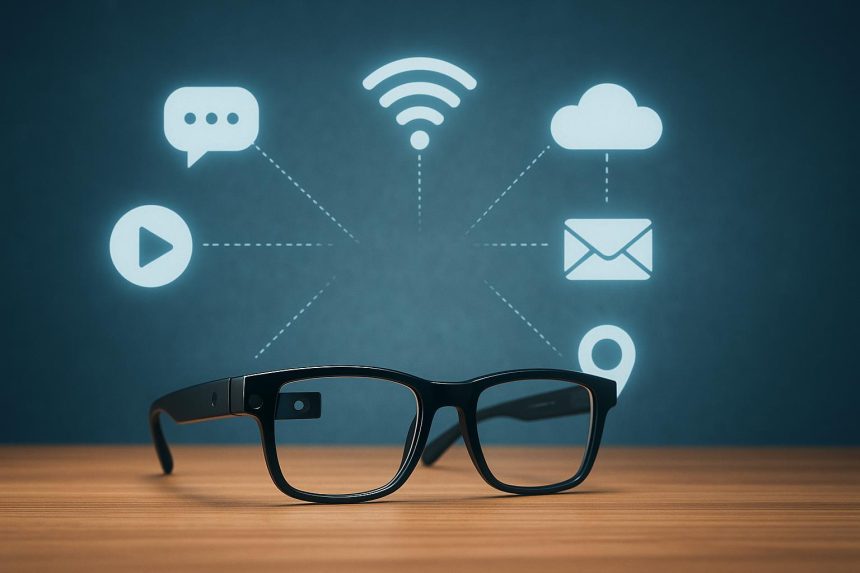
Wearable technology has been creeping into everyday life for years, but most of the conversation has centered on wrists and earbuds. Smartwatches track your steps. Wireless earphones pump audio directly into your ears. What has received far less attention — until recently — is the most natural wearable of all: glasses.
For the roughly 4 billion people worldwide who already wear corrective lenses or sunglasses, the idea of building technology into a familiar, comfortable frame is not a leap. It is the obvious next step. And the technology catching up to that idea is reshaping how people stay informed, connected, and present without being tethered to a screen.
From Novelty to Genuinely Useful
Early attempts at smart glasses were largely dismissed as awkward, expensive, and solution-looking-for-a-problem. The form factor was clunky and the use cases felt narrow. That criticism was fair at the time. But the category has matured significantly, driven by improvements in miniaturized sensors, low-power processors, and ambient AI that can understand context without demanding your full attention.
Today’s AI glasses are a far cry from those early prototypes. Paired with AI voice assistance, built-in cameras, and open-ear audio, they allow users to capture moments, answer questions, navigate, and take calls without reaching for a phone. The use cases that struggled to materialize a decade ago are now landing naturally in real daily routines: hands-free navigation on a run, live translation while traveling, or simply listening to music without blocking out the world.
Why Eyewear Makes Sense as a Tech Platform
The human face is already a hub for sensory information. Eyes process the world. Ears receive audio. A device built around that center point has access to an enormous amount of context — what you are looking at, what you are hearing, where you are. No other wearable form factor sits so close to the senses that actually matter for ambient computing.
This is why major technology companies and established eyewear brands have both been drawn to the space. The appeal is not just hardware — it is the possibility of a device that understands your environment as naturally as you do, without requiring you to pull out a phone, tap a screen, or even look down. Recent coverage from MIT Technology Review notes that smart glasses are on the verge of becoming a genuine mainstream category, driven by AI agents capable of holding context-aware conversations with wearers based on what they see.
What Buyers Should Actually Consider
The smart eyewear market has expanded quickly, and the options now range from fashion-forward audio glasses to fully integrated AI-capable frames. For most buyers, a few questions help narrow the field:
Audio quality. Open-ear speakers built into frames have improved considerably, but output still varies between products. If audio is a primary use case, it is worth listening before buying.
Battery life. A device you wear all day needs to last all day. Most current options offer between four and eight hours of active use, with charging cases extending that range.
Camera capability. Photo and video quality from frame-mounted cameras has become genuinely competitive with what you would get from a casual phone shot. For users who want to document moments without lifting a phone, this matters.
Fit and comfort. Unlike phones and earbuds, glasses have to sit comfortably on your face for hours. Weight distribution and nose pad design make a bigger difference than they might seem in a product listing. The same principle applies to any wearable device — the right fit for your daily use patterns matters more than spec sheets alone.
The Privacy Question Is Worth Answering Honestly
Any glasses with a built-in camera will raise a legitimate question: what happens to the footage, and do the people around you know it is being recorded?
It is a fair concern, and the better products in this space have taken it seriously. Most current AI glasses include a physical indicator light that activates when the camera is recording — visible to people in the frame, not just the wearer. Some manufacturers have also built in restrictions on continuous passive recording, requiring the user to actively capture rather than running indefinitely in the background.
The social norm around this is still forming, and that is honest. Wearable cameras in public spaces carry different expectations than a phone pointed at something, partly because they are less conspicuous. The reasonable approach — and the one most users settle into — is the same as with any recording device: use it transparently, tell people when you are capturing, and exercise judgment in contexts where recording would be unwelcome.
This is not a reason to avoid the technology. It is a reason to choose products from manufacturers who have thought through the design carefully, and to use them thoughtfully.
A Shift in How We Think About Connectivity
There is a broader cultural shift embedded in the rise of smart eyewear that is worth naming. The phone has become so central to daily life that looking at a screen feels like a reflex rather than a choice. Every notification pulls attention away from wherever you actually are. The cost of that, accumulated over a day, is significant in ways that are hard to measure but easy to feel.
Ambient wearables, and glasses in particular, offer a different model. A question answered through an earpiece while you keep walking. A photo taken without the ritual of unlocking a phone and framing a shot. A call managed without breaking stride. These are small things individually, but they add up to a qualitatively different relationship with technology — one that stays in the background until you need it rather than competing constantly for the foreground.
That is not a small thing. The most interesting aspect of this technology may not be the hardware itself, but what it enables: a version of connectivity that works alongside life rather than competing with it for your gaze. For anyone who has found themselves reaching for their phone out of habit rather than intention, that shift is worth paying attention to.

Lynn Martelli is an editor at Readability. She received her MFA in Creative Writing from Antioch University and has worked as an editor for over 10 years. Lynn has edited a wide variety of books, including fiction, non-fiction, memoirs, and more. In her free time, Lynn enjoys reading, writing, and spending time with her family and friends.